
At a glance
Key facts
The essentials to compare before deciding whether this breed fits your home and routine.
- Size
- Small
- Lifespan
- 12 to 15 years
- Energy
- High
- Temperament
- Bold, busy and quick to chase anything that moves
- Good with children
- Often good with children who respect an energetic dog
- Exercise
- An hour to 90 minutes a day plus scent work
- Trainability
- Moderate
- Grooming
- Weekly brushing keeps the smooth coat tidy between sheds
- Estimated monthly cost, GBP
- £80 to £140 per month
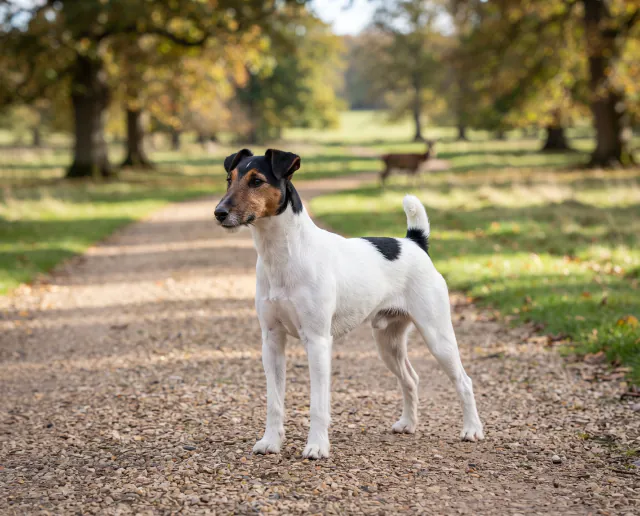
Fox hunts of the nineteenth century needed a dog small enough to follow a fox to ground and bold enough to drive it back out, and the Smooth Fox Terrier was refined for exactly that job, running with the hounds and horses across a full day’s country before doing the dangerous work underground. The breed’s sleek white coat, marked with black or tan patches, made it easy to spot at a distance in cover, a practical feature that has stayed part of the standard long after the hunting role itself declined.
Its numbers have declined too, sharply enough that the Kennel Club now classes the Smooth Fox Terrier among its vulnerable native breeds, with UK registrations running to only a few hundred a year against tens of thousands for the most popular pedigree dogs. That is a strange state of affairs for a breed once so common it was a stock character of the Edwardian household, and prospective owners should expect to wait for a puppy and to lean on the national breed club rather than a casual search.
Suitability
An active household that enjoys a dog with genuine drive and a strong sense of its own opinions tends to get the most from this breed. It is not naturally suited to a quiet, sedentary home, and boredom shows itself quickly as digging, barking or a determined effort to find an escape route. Children who are old enough to play energetically without being knocked over, and who understand that a terrier bolting after a squirrel is not being disobedient so much as doing exactly what it was bred for, generally get on well with the breed. Cats and small pets already established in the household have a reasonable chance of acceptance, but new small animals introduced later carry real risk. First time owners can succeed with this breed provided they commit properly to training and exercise from the outset rather than assuming a small dog looks after itself.
Exercise
An hour to ninety minutes of exercise a day, ideally including some off lead running in a secure area, suits most healthy adults, and a fit Smooth Fox Terrier can comfortably manage more without complaint. Scent work, flyball style games and anything that channels the breed’s prey drive productively pay off far better than a single sedate walk around the block. Puppies need considerably shorter, more frequent outings while bones and joints are still developing, since a terrier’s enthusiasm rarely matches its physical readiness at that age. Fencing deserves particular attention, since a determined fox terrier will dig under, squeeze through or occasionally scale a boundary that looks secure to a casual glance.
Grooming
The short, dense coat needs little beyond a weekly session with a rubber grooming mitt or bristle brush, which lifts loose hair before it settles into carpets and upholstery. Bathing is rarely required more than occasionally, and the coat dries quickly after a wet walk. Nails wear down reasonably well on an active dog but should still be checked regularly, along with ears, teeth and the skin around the mouth. Shedding is moderate and fairly constant through the year rather than seasonal, which suits owners who prefer a steady, manageable routine over sudden heavy moults.
Health
Twelve to fifteen years is a fair expectation for the breed, and it is generally regarded as a robust one with relatively few conditions specific to it compared with some pedigree dogs of similar age. Deafness has been documented in predominantly white coated terrier breeds generally, and a hearing test carried out on puppies from a litter with white colouring is a reasonable question to raise with a breeder. Luxating patellas and standard eye conditions checked under Kennel Club and BVA schemes are worth asking about as with most small breeds. Keeping the dog lean matters throughout its life, since a fit fox terrier carries little spare weight and extra pounds show quickly in reduced stamina and joint strain.
Choosing and training
A breeder who can talk knowledgeably about hearing testing, temperament in the litter and the working background of their lines is worth more than one offering the shortest wait. Training benefits from starting early and staying consistent, since this is a breed that learns fast, including habits an owner never intended to teach. Recall around game or strong scent needs building patiently over months, using a long line in open spaces until it is genuinely reliable, because a fox terrier that catches sight of quarry rarely remembers it has an owner nearby.
Verdict
The Smooth Fox Terrier suits an active family or individual who enjoys a lively, characterful dog, has secure outdoor space, and is prepared to support one of Britain’s genuinely rare native breeds by seeking out a proper breeder. Its long history as a versatile working terrier still shows in a dog that thrives on having a job, even an invented one.
Anyone wanting a low energy companion, an unfenced garden backing onto open fields, or a dog that manages happily with minimal daily exercise should consider elsewhere. Meeting adult dogs and discussing hearing and joint health openly with a breeder gives a far more honest picture than any kennel club standard alone.