At a glance
Key facts
The essentials to compare before deciding whether this breed fits your home and routine.
- Size
- Medium
- Lifespan
- 12 to 15 years
- Energy
- High
- Temperament
- Devoted, sensitive, busy and reserved with strangers
- Good with children
- Usually very good with children in an active family
- Exercise
- 90 minutes a day with free running and scent work
- Trainability
- Beginner friendly
- Grooming
- Brush several times weekly with regular trimming of feet and ears, moderate shedding
- Estimated monthly cost, GBP
- £85 to £150 per month
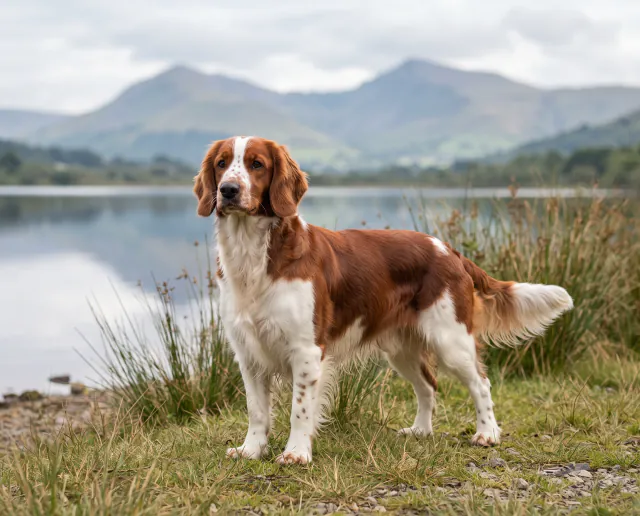
The Welsh Springer is not a colour variety of the English Springer, though the mistake is common. It is a separate and older type, recognised by the Kennel Club in 1902 and shown in a single coat pattern of rich red on pearly white, with a slightly smaller, more compact frame, a lighter head and a tail set that gives it a different outline altogether. Red and white spaniels of this kind appear in Welsh records and paintings going back several centuries, and the modern breed was consolidated in south Wales for springing game to the gun.
The temperament is different too. Where an English Springer greets the whole world as a friend, a Welsh Springer greets its own household as a friend and everyone else as a matter to be considered, and that distinction shapes most of what follows.
Temperament in the home
With its family the breed is devoted to the point of shadowing, and many will follow their owner from room to room and settle only when everyone is accounted for. That attachment has a cost. Welsh Springers are prone to separation distress when left for long periods and to anxiety if not socialised early and widely, which can leave a nervous adult barking at anything unfamiliar. Reserve with strangers is correct for the breed, and timidity is not. Around the house they are busy, gentle and generally quiet once the doorbell has been dealt with, and the mouth is soft, good at carrying and bad at leaving shoes alone. Children are usually well tolerated and the breed is steady enough for a family that includes it in life. Other dogs are typically fine and cats can be managed with an early introduction, though the hunting instinct runs deep and small pets outdoors are at risk.
Exercise and training
This is an active gundog and an adult needs around ninety minutes a day, with a good part of it off lead where safe, and the breed will take far more. Scent is what it lives for, and a walk through woods, along a river or over rough ground where the dog can hunt cover satisfies it far more than a pavement route. Many owners find gundog training, working tests or scent work the natural outlet, and the breed retains enough working ability to be useful on a rough shoot. Recall must be taught early and thoroughly, because a Welsh Springer that has hit a scent line will follow it, and the lead goes on near sheep. Puppies need the usual restraint of short walks and no forced running until about a year old. Training is a pleasure with a handler who stays calm. The breed is intelligent and cooperative but soft, and a harsh word does lasting damage. Reward and short sessions achieve far more than correction.
Coat and grooming
The coat is straight, flat and silky, red and white, with moderate feathering on the legs, chest and ears that is lighter than the English Springer’s. Brushing two or three times a week with a slicker and a comb keeps it free of tangles, and the feet, hocks and ear edges are trimmed every few weeks to stop them collecting mud, burrs and seeds. Shedding is moderate and steady, with a heavier loss in spring. The ears are set lower and smaller than an English Springer’s, but still trap moisture and need lifting and checking weekly, particularly after swimming, which most of the breed enjoys. A groomer can tidy a pet dog two or three times a year, though many owners manage it at home with scissors and a little practice.
Health and lifespan
Twelve to fifteen years is usual and the breed is generally hardy. The breed is not free of hip dysplasia, so both parents should have been hip scored under the BVA and Kennel Club scheme. Eye problems are the other significant area, with glaucoma recognised, so a gonioscopy examination for the predisposing eye anatomy, alongside an annual eye examination under the same scheme, is the sensible request. Entropion, where the eyelid rolls inwards, is also seen. Epilepsy is recognised within the breed and a good breeder will be open about what their lines have produced. Low thyroid function is reported. Weight management is rarely a struggle in a dog that exercises this much. Ear infections are the ordinary running cost of a spaniel that swims and pushes through wet cover.
Costs and space
Monthly costs are moderate, in the region of £85 to £150 across food, insurance, veterinary care and periodic grooming, varying with insurer and region. Space is less important than access to exercise, and a Welsh Springer is far happier in a small terraced house near open country than a large house on a busy road. A secure garden is close to essential because the breed will follow its nose through any gap. Puppies are easier to find than for the rarer spaniels but harder than for the English Springer. The breed clubs in England and Wales are the sensible starting point, litters tend to be planned a year ahead and a wait of several months is normal. Rescue dogs come up occasionally through the clubs and usually need an owner who understands the breed’s sensitivity.
Verdict
The Welsh Springer suits an active household that is at home a good deal, walks in all weather, enjoys training and wants a gundog that is gentler and more reserved than the English Springer while still capable of a full day’s work.
Owners who are out all day, who want a dog that adores every stranger, or who prefer a robust, thick skinned animal that shrugs off a telling off should look at the English Springer or a Labrador instead. Poorly socialised Welsh Springers are anxious dogs, and that is the failure to avoid.