
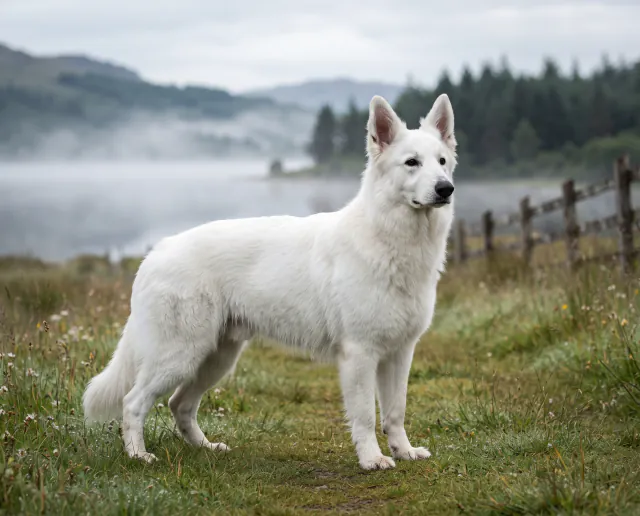
Also known as: White Shepherd, Berger Blanc Suisse.
At a glance
Key facts
The essentials to compare before deciding whether this breed fits your home and routine.
- Size
- Large
- Lifespan
- 10 to 12 years
- Energy
- High
- Temperament
- Sensitive, watchful and closely bonded to its family
- Good with children
- Usually very good with family children
- Exercise
- Over an hour a day plus structured mental work
- Trainability
- Moderate
- Grooming
- Brushing several times a week, with a heavy seasonal blowout
- Estimated monthly cost, GBP
- £110 to £190 per month
White coated shepherd dogs appear in early German Shepherd bloodlines, but the colour fell out of favour with breed clubs on the continent long before it disappeared from working lines in North America, where it was preserved and eventually developed into a distinct type. Swiss breeders later took that white shepherd stock and refined it into the breed recognised today, gaining international recognition only in the past few decades. The result looks unmistakably like a German Shepherd with the colour bred out, but temperament has diverged in a genuinely useful direction for family life.
Breeders and owners consistently describe the White Swiss Shepherd Dog as softer and more biddable than its darker relative, less inclined toward sharp guarding behaviour and generally easier to live with in a busy household. That gentler nature has not been won at the cost of intelligence or energy, and a dog this capable still needs an owner who understands working breed needs rather than one drawn purely by the striking white coat.
Suitability
Families tend to do well with the breed, since it is typically affectionate, patient and eager to be included in whatever the household is doing, with a watchfulness that leans toward alertness rather than aggression. The dog’s sensitivity is worth understanding before buying, because sharp voices, chaotic households or inconsistent handling can produce a genuinely anxious animal rather than a resilient one. Given the breed’s origins in a working, highly social type, being left alone for long stretches suits it badly, and separation related problems are a realistic risk in a household that is out all day. The breed remains uncommon in most countries, so buyers should expect a wait for a litter from a breeder who health tests properly, and contacting the breed club early is the sensible first step, with some puppies still coming from imported lines.
Exercise
An hour or more of proper activity most days suits an adult, and the breed’s working ancestry means a walk alone rarely satisfies it fully. Structured activities such as obedience, agility, tracking and controlled retrieving give the dog a job to focus on, and a White Swiss Shepherd Dog without that outlet tends to invent its own projects, often involving furniture, garden borders or an unimpressed cat. Puppies should have exercise limited and varied while their joints develop, since rapid growth on a large frame is easily overloaded by repeated jumping or long runs on hard ground. Secure off lead space matters given the breed’s speed and enthusiasm for chasing.
Grooming
The medium length double coat sheds continuously and heavily during the twice yearly blowout, when daily brushing becomes genuinely necessary to keep the house manageable. Outside those periods three or four sessions a week with an undercoat rake and slicker brush through the ruff, trousers and tail keep shedding under control and prevent matting behind the ears and elbows. The coat is naturally weather resistant, and frequent bathing does more harm than good by stripping the oils that keep it that way. Nails, ears and teeth all need routine attention, and the dense undercoat around the neck and hindquarters is worth checking regularly for hidden mats even when the outer coat looks tidy.
Health
Hip and elbow scoring under the BVA and Kennel Club scheme matters here as it does for any large, active breed, and buyers should ask to see both parents’ results rather than take reassurance without evidence. Degenerative myelopathy, a progressive spinal cord condition documented in shepherd type breeds, has a DNA test available, and responsible breeders use it to avoid producing affected puppies. Bloat is a risk in any large, deep chested dog, and owners benefit from knowing the emergency signs, restlessness, unproductive retching and a swollen abdomen, well before they might need that knowledge. Because the breed carries real energy and drive, keeping it at a lean working weight throughout life protects joints considerably more than any supplement could.
Choosing and training
Gentle, consistent, reward based training suits the breed’s sensitivity far better than firm correction, which can produce a worried, shut down dog rather than a compliant one. Early socialising with people, places and everyday noise builds the confidence a working breed needs to cope calmly with a normal domestic life. Litters are genuinely scarce, and prospective owners should expect to join a waiting list through the breed club rather than find a puppy through general advertising, with the club also a useful source of honest advice about temperament and suitability. Meeting adult dogs before committing gives a far more accurate picture of the breed’s needs than any amount of reading, and a breeder who health tests thoroughly and raises puppies in a home environment is worth waiting for.
Verdict
The White Swiss Shepherd Dog suits an active family with time for daily structured exercise, patience for a sensitive temperament, and enough space for a large, energetic dog to live comfortably. Owners who enjoy training and want a devoted, watchful companion rather than a guard dog tend to find the breed a rewarding choice.
It is a poor fit for anyone wanting a low shedding coat, a dog that copes well alone, or a household with a harsh or inconsistent approach to correction. The gentler temperament that sets this breed apart from other shepherd types still comes wrapped around a large, driven, working dog underneath.