Also known as: Malinois, Belgian Shepherd Dog (Malinois), Mechelse Herder.
At a glance
Key facts
The essentials to compare before deciding whether this breed fits your home and routine.
- Size
- Large
- Lifespan
- 12 to 14 years
- Energy
- Very high
- Temperament
- Intense, fast to react and happiest with a job
- Good with children
- Better with older children who understand how to behave around a busy dog
- Exercise
- Two hours or more, most of it structured rather than free running
- Trainability
- Experienced handler
- Grooming
- A weekly brush, with two heavy moults a year
- Estimated monthly cost, GBP
- £110 to £210 per month
The Malinois is the short-coated fawn variety of the Belgian Shepherd, named after Malines, the French name for the Belgian city of Mechelen. Of the four varieties it is by some distance the best known, because over the last forty years it has become the standard working dog of police forces and armed services worldwide. That reputation is deserved, and it is also the single biggest reason people buy one and then struggle.
Origin and what it was bred to do
All four Belgian varieties come from the same late nineteenth century effort to organise the farm shepherd dogs of Belgium into one recognised breed, standardised in the 1890s and separated by coat rather than by ability. The Malinois was the herding and general farm type around Mechelen, and it kept working long after the others drifted towards the show ring. That is the reason it is the variety that ended up in service work: breeders selected for drive, nerve and the willingness to keep going, and they did so continuously rather than in a revival.
Modern Malinois lines split roughly into working lines bred for police, military and protection sport, and show lines bred to the Kennel Club standard. A working-line puppy is not a slightly keener pet. It is a dog selected across generations for the intensity that makes handlers want it, and dropping that into a normal household without a serious daily outlet is where most of the breed’s rehoming problem comes from.
Coat, colour and grooming
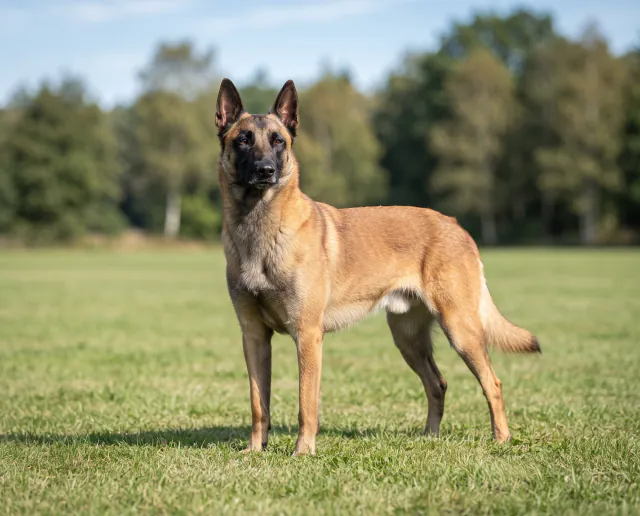
The coat is short, thick and close, with a firm texture over a woolly undercoat, and it is neither silky nor wiry. The hair is very short on the head, the outside of the ears and the lower legs, with a longer collar of hair around the neck and more on the tail. Colour is all shades of red, fawn and grey with a black overlay, where the tips of the pale hairs are blackened. On a mature male that dusting is heaviest over the shoulders, back and ribs, and it should read as a dusting rather than a solid black saddle. A black mask is characteristic, and a little white is tolerated on the forechest and toes.
Grooming is the easiest thing about the breed. A weekly brush keeps the coat in order for most of the year, with two heavier moults where a rubber curry or a short-coat rake earns its place. This is a low-maintenance coat that sheds a surprising amount for its length.
Size and build
The Kennel Club gives an ideal height of 61 to 66 cm (24 to 26 in) for dogs and 56 to 61 cm (22 to 24 in) for bitches, with weight in proportion to size rather than a stated range. In practice most adults sit somewhere between 20 and 30 kg (44 to 66 lb). The build is square and light rather than heavy, closer to a boxer’s outline than a German Shepherd’s, with a level topline and no exaggerated rear angulation. A Malinois should look like it could run all day, because it can.
Temperament and daily life
The defining trait is reactivity in the neutral sense: this dog notices everything and does something about it. A car in the drive, a jogger across the field, a cat, a bicycle, a dropped bag. That makes an outstanding working partner and a demanding companion. Malinois bond very hard to one or two people, are naturally reserved with strangers, and do not settle easily on their own. Separation problems and destruction are common complaints, and they are usually a symptom of an unspent dog rather than a training failure in isolation.
Around children, this is a variety that suits older ones. Puppies and adolescents use their mouths readily, they herd movement, and they are fast and strong enough that a knock is a real knock. Households with toddlers should look elsewhere among the four. With other dogs, careful early socialisation matters and same-sex tension is not unusual. Small pets are a poor bet given the chase drive.
Exercise and training
Two hours a day is a floor, not a target, and the composition matters more than the total. Mileage alone produces a fitter dog with the same unmet need. What works is structured work: obedience, scentwork, tracking, retrieve games with rules, tug with a clear start and finish, and a genuine off switch trained deliberately from the start. Belgian ringsport, mondioring, IGP, agility and working trials all exist because this dog needs a job, and any owner without access to something like one should think hard.
Training itself is a pleasure and a trap. Malinois learn at speed and will happily learn the wrong thing just as fast. They are sensitive to handler tension and to unclear signals, so a handler who nags, repeats cues or escalates gets a dog that either shuts down or winds up. Clear criteria, short sessions, high-value reinforcement and consistency across the household are what this variety rewards. Recall around livestock and traffic must be genuinely proofed before any off-lead freedom.
Health considerations
Expect twelve to fourteen years. Hip and elbow dysplasia are screened for, and hip and elbow scores for both parents should be available in writing. Inherited eye disease, including progressive retinal atrophy, is also screened for, and epilepsy is recognised in the breed, so ask a breeder directly about seizures in the line rather than only about the tested conditions. The build is athletic and injuries from repetitive high-impact work, particularly in adolescence, are worth avoiding: keep jumping and hard turns modest until growth plates close.
Costs, home and who this suits
Around £110 to £210 a month is realistic, including food for an active large dog, insurance for a breed with a working reputation, and the classes or club membership this variety genuinely needs. Insurance quotes vary more than usual here, so get them before committing.
The Malinois suits an experienced owner with a physically active life, secure fencing, time every single day, and preferably a dog sport or working discipline. It is a poor choice for a first dog, for a household that is out all day, for anyone who wanted a jogging partner rather than a training partner, or for a family with very young children. If the working reputation appeals but the intensity does not, the Belgian Tervueren or Belgian Groenendael are usually the more liveable choices, and the Belgian Shepherd varieties overview sets all four side by side.