Also known as: Tervueren, Tervuren, Belgian Shepherd Dog (Tervueren).
At a glance
Key facts
The essentials to compare before deciding whether this breed fits your home and routine.
- Size
- Large
- Lifespan
- 12 to 14 years
- Energy
- Very high
- Temperament
- Sensitive, watchful and closely tuned to its handler
- Good with children
- Good with children who are calm and predictable around dogs
- Exercise
- Two hours or more, with real mental work included
- Trainability
- Experienced handler
- Grooming
- Two or three brushes a week, daily through a moult
- Estimated monthly cost, GBP
- £110 to £210 per month
The Tervueren is the long-coated fawn variety of the Belgian Shepherd, named after the village of Tervuren near Brussels where the type was established. It is the variety people often arrive at after meeting a Malinois and deciding they want the ability without quite that much of it, which is roughly right, though the gap is narrower than the reputation suggests.
Origin and what it was bred to do
The four Belgian varieties were organised into one breed in the 1890s from the working farm dogs of different Belgian districts, separated by coat rather than by job. The Tervueren descends from the long-coated fawn dogs around Tervuren, and its early history is tied to a small number of foundation dogs, which is part of why the variety has always been numerically modest compared with the Malinois.
Its work was the same as the others: moving and containing stock, guarding the holding, and being generally useful on a farm. Modern Tervueren are widely used in obedience, agility, working trials, tracking and search work, and are less dominant than the Malinois in police and military service mainly because coat maintenance and a somewhat softer temperament suit service conditions less well.
Coat, colour and grooming
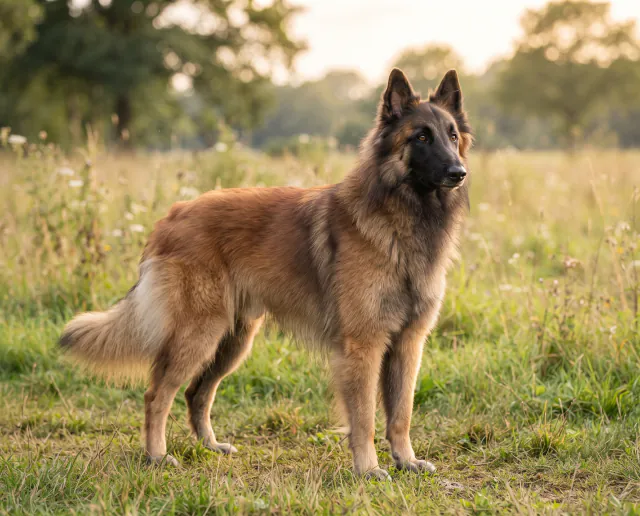
The outer coat is long, straight and abundant with an extremely dense undercoat, of medium harshness and neither silky nor wiry. Males carry noticeably heavier coats than females, with a pronounced ruff around the neck, feathering on the legs and a well-furnished tail. Colour is all shades of red, fawn and grey with a black overlay, and the coat is characteristically double pigmented, with the tips of the pale hairs blackened. On a mature male that blackening concentrates over the shoulders, back and ribs and should look like a dusting rather than a solid black area. A black mask is typical, and a small amount of white is tolerated on the forechest and toes.
This is the practical difference from the Malinois. Two or three thorough brushes a week keep the coat clear, and it must reach the dense undercoat rather than skate over the top, or the dog will mat behind the ears, in the ruff and behind the elbows. Twice a year the undercoat comes out in quantity and daily work is needed for a couple of weeks. Do not clip the coat: it insulates in both directions and the texture rarely recovers.
Size and build
Ideal height under the Kennel Club standard is 61 to 66 cm (24 to 26 in) for dogs and 56 to 61 cm (22 to 24 in) for bitches, with weight in proportion rather than a stated range, which in practice usually means 20 to 30 kg (44 to 66 lb). The outline is square and elegant, lighter in bone than a German Shepherd, and the abundant coat makes the dog look larger than it weighs.
Temperament and daily life
Tervueren are watchful, strongly bonded and noticeably sensitive. They read a household’s mood, and they read their handler in particular, which is a gift when things are going well and a liability when they are not. A tense or inconsistent handler produces a worried dog rather than a defiant one. Harsh handling is counterproductive with this variety in a way it is not with some tougher breeds.
Reserve with strangers is normal and should not be mistaken for a fault, but it does need proper early socialisation to stay as reserve rather than becoming suspicion. Many Tervueren are barky, alerting to movement and sound outside, and this is worth shaping into a short alert and a settle early on.
With children who are calm and predictable, most are good. The herding instinct means running and shrieking invites circling and occasionally nipping at heels, so supervision and redirection matter while the dog is young. With other dogs they are usually sociable given decent early experience, and small furry pets need managing given the chase drive.
Exercise and training
Two hours or more a day, and as with every Belgian variety the content matters more than the distance. Physical exercise alone builds stamina without touching the need to think. Scentwork, tracking, obedience, agility, trick training and structured retrieve games all suit the Tervueren well, and the variety is a strong performer in competitive obedience and working trials specifically because it enjoys precision.
Trainability is high, with the caveat that sensitivity cuts both ways. Short, upbeat sessions with clear criteria and generous reinforcement get an enormous amount from this dog. Repetition without progress, drilling, or correction the dog does not understand will cost you engagement quickly. Teach a genuine settle from puppyhood; a Tervueren left to self-regulate usually chooses vigilance.
Health considerations
Twelve to fourteen years is normal. Hip and elbow dysplasia are screened for, and scores for both parents should be available in writing. Inherited eye disease including progressive retinal atrophy is screened for, and epilepsy is recognised across the Belgian varieties, so ask specifically about seizures in the line. Because the Tervueren population is small, questions about how closely related the parents are matter more here than in a numerous breed.
Costs, home and who this suits
Budget around £110 to £210 a month for food, insurance, training and the occasional professional groom if the coat gets away from you. A secure garden with real fencing is close to essential, and a rural or suburban home with space suits the breed better than a flat.
The Tervueren suits an experienced, active owner who wants a training partner and is happy to do the coat work. It is a genuinely rewarding dog for anyone who enjoys teaching. It is a poor choice for a first-time owner, for a household out all day, or for anyone who does not want to brush a large dog several times a week. If the coat is the sticking point but the temperament appeals, look at the Belgian Malinois; if the colour is the draw, the Belgian Groenendael is the same dog in solid black. The Belgian Shepherd varieties overview compares all four.