Also known as: Laekenois, Belgian Shepherd Dog (Laekenois), Laken.
At a glance
Key facts
The essentials to compare before deciding whether this breed fits your home and routine.
- Size
- Large
- Lifespan
- 12 to 14 years
- Energy
- Very high
- Temperament
- Robust, watchful and less demonstrative than the other three
- Good with children
- Suits calm households; supervise while the dog is young
- Exercise
- Two hours or more, with a job to do inside it
- Trainability
- Experienced handler
- Grooming
- A weekly comb through, plus hand stripping a few times a year
- Estimated monthly cost, GBP
- £110 to £210 per month
The Laekenois is the rough-coated variety of the Belgian Shepherd and the one most people have never seen. It takes its name from Laeken, the district of Brussels associated with the royal château, where the wire-coated fawn dogs were concentrated. Numerically it has always been the smallest of the four varieties, and finding a litter usually means waiting and travelling.
Origin and what it was bred to do
The Belgian Shepherd was standardised in the 1890s from the farm dogs of different Belgian districts, divided into four varieties by coat rather than by ability. The Laekenois came from the wire-coated dogs of the Laeken area, where they worked stock and, distinctively, guarded drying linen in the fields, a job that suited a weatherproof coat and a dog willing to challenge a stranger.
The variety’s numbers were badly hit by both world wars and have never fully recovered. Where the Malinois went into police service and the Groenendael and Tervueren into the show ring and dog sport, the Laekenois stayed small and quietly working, which is why it is the least standardised in appearance of the four and the hardest to find.
Coat, colour and grooming
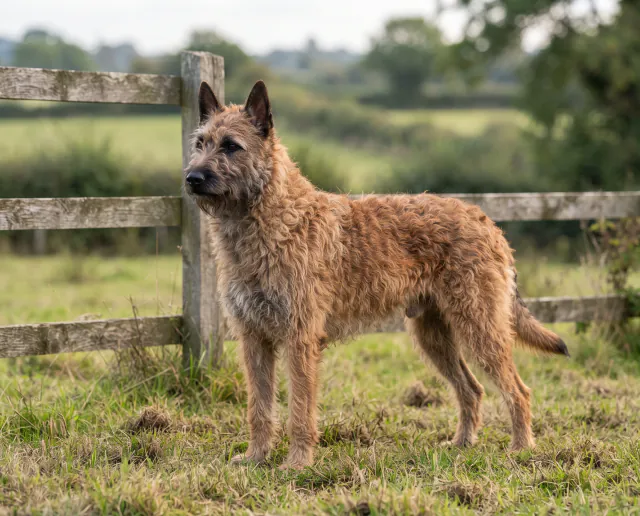
The coat is the whole point of the variety: harsh, wiry and dry, and specifically not curly, roughly 6 cm (2½ in) long over the body, and shorter on the top of the muzzle, the forehead and the legs. The overall impression is deliberately untidy, with a tousled beard and eyebrows. Colour is reddish fawn with black shading, concentrated principally in the muzzle and tail, which is a narrower colour clause than the fawn worn by the Malinois and Tervueren.
Grooming is different from the other three rather than harder in every way. Shedding is more moderate because the harsh coat holds dead hair rather than dropping it, but that hair has to be taken out by hand. A weekly comb and finger-work through the coat keeps it open, and the coat needs hand stripping a few times a year to keep its texture. Clipping is the mistake to avoid: it cuts the harsh outer hair, leaves the softer undercoat behind, and produces a soft, woolly, matting coat that loses both its weatherproofing and its appearance, sometimes permanently. Anyone unwilling to learn stripping or to pay a groomer who can should choose a different variety.
Size and build
Ideal height under the Kennel Club standard is 61 to 66 cm (24 to 26 in) for dogs and 56 to 61 cm (22 to 24 in) for bitches, with weight in proportion rather than a stated range, which usually means 20 to 30 kg (44 to 66 lb). The frame is the same square, athletic outline as the other three; the rough coat simply disguises it, and a Laekenois often looks rangier and less finished than a Tervueren of identical build.
Temperament and daily life
Laekenois are generally described as the most robust and least demonstrative of the four. They are watchful, self-possessed and slower to fuss over a stranger than a Tervueren, and their guarding history shows in a readiness to notice and challenge. That makes early, thorough and unhurried socialisation more important here than in any of the other varieties, not less.
They attach hard to their own household and are poor candidates for long days alone. Alert barking is normal and worth shaping early. With children they suit a calm household, and while the dog is young the usual herding response to running and noise needs redirecting rather than punishing. With other dogs they are usually workable given good early experience, though the variety’s directness means introductions deserve care.
Exercise and training
Two hours or more a day, structured rather than simply long. Like every Belgian variety, a Laekenois given distance and no thinking becomes an extremely fit dog with an unmet need. Tracking and scentwork suit the variety particularly well, and obedience, agility and working trials all work. Because so few are bred, there is less established sport-line specialism than in the Malinois, and individual dogs vary more.
Trainability is high but the variety is often described as more independent-minded than the Tervueren and less immediately biddable than the Malinois. Clear criteria, short sessions and reinforcement the dog actually values are what pay. A settled off switch has to be taught deliberately.
Health considerations
Twelve to fourteen years is usual. Hip and elbow dysplasia are screened for, and scores for both parents should be available in writing. Inherited eye disease including progressive retinal atrophy is screened for, and epilepsy is recognised across the Belgian varieties, so ask directly about seizures in the line. The small population makes questions about how closely the parents are related more pressing here than in any of the other three varieties, and a breeder who cannot answer that clearly is telling you something.
Costs, home and who this suits
Around £110 to £210 a month covers food, insurance, training and either grooming tools or a groomer who understands hand stripping. Expect a longer wait and probably a longer journey to find a puppy than for the other varieties, and be sceptical of anyone offering one readily.
The Laekenois suits an experienced owner who wants a working Belgian Shepherd, is prepared for a coat that must be stripped rather than clipped, and is patient enough to wait for the right litter. It is a poor choice for a first-time owner, for a household out all day, or for anyone who wanted the look without the coat work. If the temperament appeals but the coat does not, the Belgian Malinois is the low-maintenance option and the Belgian Tervueren the closest in colour. The Belgian Shepherd varieties overview compares all four side by side.