At a glance
Key facts
The essentials to compare before deciding whether this breed fits your home and routine.
- Size
- Large
- Lifespan
- 12 to 14 years
- Energy
- Very high
- Temperament
- One temperament across four coats, with the Malinois the most intense
- Good with children
- Workable for all four with training; the Malinois suits older children
- Exercise
- Two hours or more a day for any of the four
- Trainability
- Experienced handler
- Grooming
- Depends entirely on the variety, from a weekly brush to hand stripping
- Estimated monthly cost, GBP
- £110 to £210 per month
Belgian Shepherd is one breed with four varieties. The Kennel Club judges the Malinois, Tervueren, Groenendael and Laekenois to the same standard, differing only in coat colour, texture and length. Everything else in that standard, the size, the outline, the construction and the temperament, is written once and applies to all four.
That single fact resolves most of the confusion around the breed. The varieties are not four temperaments in four coats. They are one dog wearing four coats, with real differences in intensity and upkeep that follow from decades of separate breeding rather than from the standard. This page covers what they share and how to choose between them; each variety has its own full profile.
One origin, four districts
Belgian farm shepherd dogs were an unorganised population until the early 1890s, when a group of Belgian enthusiasts set out to sort them into a recognised breed. What they found was a consistent working dog in an inconsistent set of coats, so the breed was defined by structure and the coats were formalised as varieties, each associated with the district where that type was concentrated: Malines for the short-coated fawn, Tervuren for the long-coated fawn, Groenendaal for the long-coated black, and Laeken for the rough-coated fawn.
The job was the same everywhere. These were general-purpose farm dogs that moved and held stock, watched the yard and dealt with whatever came up the lane. That history explains the shared traits: the athleticism, the reserve with strangers, the alert barking, the strong attachment to one household, and the constant need to be doing something.
What separated the varieties afterwards was fashion and function. The Malinois stayed in working hands and became the standard police and military dog worldwide. The Groenendael and Tervueren moved substantially towards the show ring and dog sport. The Laekenois nearly disappeared twice and remains rare. Those histories, not the standard, are the reason a working-line Malinois feels different in a living room from a show-line Tervueren.
Coat and colour: the actual differences
Coat is what the standard uses to tell them apart, and it is also the difference that most changes daily life.
The Groenendael and Tervueren share a coat description: long, straight and abundant, of medium harshness, neither silky nor wiry, over an extremely dense undercoat. Males carry heavier coats with a pronounced ruff. Both need two or three thorough brushes a week that reach the undercoat, and daily work through two heavy moults a year.
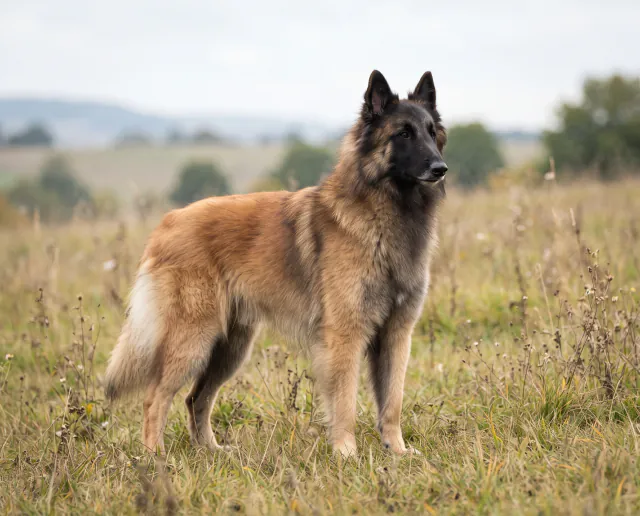
They differ only in colour. The Groenendael is black, and white or grey frosting on the muzzle is normal in the variety rather than a fault. The Tervueren is all shades of red, fawn or grey with a black overlay, double pigmented so the tips of pale hairs are blackened, heaviest over the shoulders, back and ribs on a mature male, and read as a dusting rather than a solid saddle.
The Malinois shares the Tervueren’s colour clause exactly and wears it on a short coat: thick, close, firm in texture over a woolly undercoat, very short on the head, the outside of the ears and the lower legs. A weekly brush covers it. This is the lowest-maintenance coat of the four and it still sheds heavily twice a year.
The Laekenois is the outlier. Its coat is harsh, wiry and dry, specifically not curly, about 6 cm (2½ in) long over the body and shorter on the muzzle, forehead and legs, giving a deliberately tousled look with beard and eyebrows. Its colour clause is narrower than the fawn varieties: reddish fawn with black shading, principally in the muzzle and tail. Crucially, this coat is stripped by hand a few times a year, not clipped. Clipping a wire coat removes the harsh outer hair, leaves the soft undercoat, and produces a woolly, matting coat that loses its weatherproofing and often never recovers its texture.
What is the same across all four
Size does not vary by variety. The standard gives an ideal 61 to 66 cm (24 to 26 in) at the shoulder for dogs and 56 to 61 cm (22 to 24 in) for bitches, with weight in proportion rather than a stated range, which in practice means most adults are somewhere between 20 and 30 kg (44 to 66 lb).
Exercise does not vary either. Two hours or more a day is the baseline for any of the four, and for all of them the composition matters more than the distance. A Belgian Shepherd given long walks and nothing to think about becomes a very fit dog with the same unmet need. Tracking, scentwork, obedience, agility and working trials all suit the breed, and an owner without access to something along those lines should think carefully before buying any variety.
Health is shared as well. Expect twelve to fourteen years. Hip and elbow dysplasia are screened for and scores for both parents should be available in writing. Inherited eye disease including progressive retinal atrophy is screened for, and epilepsy is recognised across the varieties, so ask a breeder directly about seizures in the line rather than only about the tested conditions. The three rarer varieties all have small breeding populations, so ask how closely related the parents are as a matter of routine.
None of the four suits a household that is out all day, and none is a sensible first dog.
Choosing between them
The honest short version is that coat and intensity are the two axes.
Choose the Malinois if you want the highest drive and the easiest coat, you have a working discipline or dog sport in mind, and you are experienced enough to handle a dog that reacts to everything quickly. It is the least forgiving of the four to own as a pet, and it suits older children rather than toddlers.
Choose the Tervueren if you want most of that ability in a more sensitive package and you are willing to brush a large double coat several times a week. It is the strongest all-round choice for an experienced owner who wants a training partner rather than a service dog.
Choose the Groenendael if the solid black long coat is what draws you and you accept the same grooming commitment as the Tervueren. Temperamentally the two are close, and either is a better first Belgian than a Malinois.
Choose the Laekenois if you specifically want the rough coat, you are prepared to learn hand stripping or pay someone who can, and you are patient enough to wait for a rare litter. Expect a slightly more independent and more directly guarding dog than the other three.
If none of those descriptions sounds like the dog you had in mind, that is useful information. This is a breed with an outstanding reputation for ability and a poor record of ending up in the right homes, and the German Shepherd comparison is worth reading before committing to any of the four.
Sources
- Belgian Shepherd Dog (Malinois) breed standard, covering coat, colour and size, The Kennel Club
- Belgian Shepherd Dog (Tervueren) breed standard, covering coat and colour, The Kennel Club
- Belgian Shepherd Dog (Groenendael) breed standard, The Kennel Club
- Belgian Shepherd Dog (Laekenois) breed standard, covering coat and colour, The Kennel Club