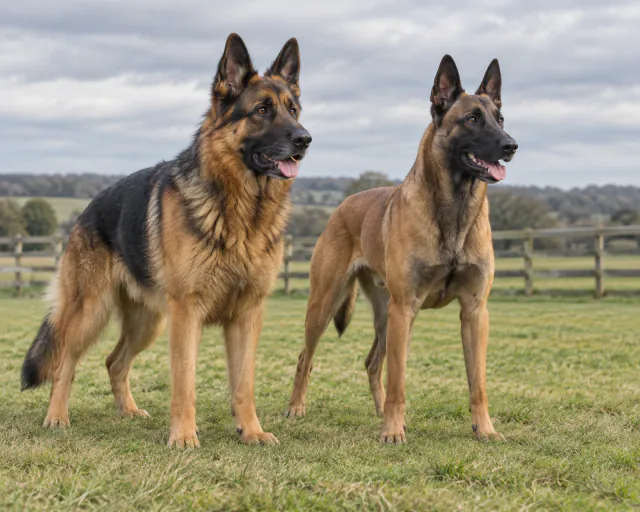
German Shepherds and Belgian Shepherd Dogs are compared constantly because both descend from continental European herding stock, both were adopted heavily into police, military and protection work during the twentieth century, and both attract owners who want a capable, intelligent working partner rather than a purely domestic pet. Anyone shopping for a large, driven working breed is likely to have both names on the shortlist, and the two are close enough in silhouette that people unfamiliar with either breed sometimes confuse them at a glance.
The full detail on each breed is worth reading first: the German Shepherd profile and the Belgian Shepherd varieties overview both cover origin, the four Belgian coat varieties, and the experience level each breed expects from an owner. Each Belgian variety now has its own profile: Malinois, Tervueren, Groenendael and Laekenois.
At a glance
| Trait | German Shepherd | Belgian Shepherd Dog |
|---|---|---|
| Size | Large (60 to 65 cm, 30 to 40 kg for males) | Large |
| Coat and shedding | Medium double coat, high shedding | Varies by variety, short to long, high shedding |
| Grooming need | High, brush several times weekly | Moderate, weekly brushing, more for longer coats |
| Energy level | High | Very high |
| Exercise | At least 2 hours a day | Two hours or more, plus structured training |
| Trainability | Experienced handler | Experienced handler |
| Good with children | Supervision important | Supervision important |
| First-time owner suitability | Experienced owner preferred | Experienced owner preferred |
| Home suitability | Medium home | Large home or rural setting |
| Barking | Moderate | High |
| Typical lifespan | 9 to 13 years | 12 to 14 years |
| Indicative monthly cost | £110 to £190 | £110 to £210 |
Temperament and personality differences
Both breeds are alert, loyal and quick to notice change in their environment, a direct result of being bred to watch over livestock and, later, to work closely with a human handler on demanding tasks. The German Shepherd’s own page describes it as loyal, alert and responsive, with a tendency to patrol and monitor household activity that comes from its tending-dog history rather than trained guarding behaviour. The Belgian Shepherd Dog’s page goes further, describing all four of its coat varieties as alert, driven and highly responsive to training, with a breed built to notice everything and react to it rather than settle.
The clearest difference is intensity. The Belgian Shepherd Dog’s page says the Malinois variety in particular carries the most drive of the four varieties and is the most likely to become genuinely difficult without a serious daily outlet, and that the breed as a whole is generally the more intense and more demanding of the two to live with as a pet. The German Shepherd is still firmly rated for experienced owners, but its page does not carry the same explicit warning about a specific variety exceeding the others in intensity.
Exercise and energy differences
Both breeds need serious daily commitment. The German Shepherd’s page states at least two hours of exercise plus mental work, while the Belgian Shepherd Dog’s page states two hours or more as a realistic minimum rather than an upper limit, with an added note that the activity needs structure, not just distance covered. The Belgian Shepherd Dog is rated very high energy against the German Shepherd’s high energy rating, and its page specifically credits owners who compete in agility, obedience, herding trials, tracking or protection sport with having the most settled dogs, because the structured training absorbs drive that would otherwise surface as chasing traffic, herding children or fence patrolling.
Both breeds benefit from a mix of steady walking, obedience work and mentally engaging tasks rather than repetitive high-speed activity, which both breed pages caution can increase arousal or load young joints unnecessarily.
Grooming and coat differences
Coat care differs more between the two than almost any other trait. The German Shepherd carries a single medium double coat rated high grooming need, with brushing several times a week required to manage heavy, near-constant shedding. The Belgian Shepherd Dog is registered as a single breed split into four coat varieties: the short-coated Malinois needs only a weekly brush, the longer-coated Groenendael and Tervueren need brushing two or three times a week, and the wire-coated Laekenois needs occasional hand stripping in addition to regular brushing. Overall the Belgian Shepherd Dog’s grooming need is rated moderate rather than high, reflecting that the easiest-coated variety, the Malinois, is also the most commonly kept.
Both breeds shed heavily regardless of variety chosen, so neither suits a home with a strong aversion to dog hair.
Training and trainability differences
Both breeds are rated for experienced handlers rather than first-time owners, and both are highly intelligent, which their own pages frame as a double-edged trait: capable of learning quickly, but also quick to find and exploit gaps in inconsistent handling. The German Shepherd’s page recommends seeking qualified help early if the dog becomes fearful or reactive, given its physical strength. The Belgian Shepherd Dog’s page makes a similar point but frames training as more central to the breed’s wellbeing overall, stating that firm, confident, reward-based handling from puppyhood matters more with this breed than with almost any other herding breed, and that dogs given a genuine daily job, whether sport, structured training or working stock, tend to be the most settled.
Health and lifespan differences
The German Shepherd’s typical lifespan sits at 9 to 13 years, with the breed median toward the lower half of that range according to its own page. The Belgian Shepherd Dog’s typical lifespan is 12 to 14 years, a meaningfully longer figure for a dog of comparable size and activity level. Both breeds require hip and elbow screening through recognised schemes such as the BVA and Kennel Club programmes, and both have documented eye conditions worth checking through the relevant scheme. The Belgian Shepherd Dog’s page additionally notes that epilepsy has been documented within its lines and is worth asking a breeder about directly. Neither of these points is a certainty for an individual dog, and both breed pages recommend taking any health certificate to your own vet rather than accepting a verbal summary.
Cost and space differences
Both breeds carry similar and comparatively high monthly costs, £110 to £190 for the German Shepherd and £110 to £210 for the Belgian Shepherd Dog, driven in both cases less by food and more by training, equipment and the insurance premiums that come with a large, intelligent, high-drive dog. The clearest practical difference is space: the German Shepherd is listed as suited to a medium home, while the Belgian Shepherd Dog is listed as needing a large home or rural setting, with its own page stating that a flat is realistic only for an owner committed to extensive daily outings and training elsewhere.
Which one suits you?
If you want a large, intelligent working breed and can offer at least two hours of daily activity, consistent training and an experienced approach to handling, either breed can be an excellent working partner. The German Shepherd is the more moderate of the two in practical terms, fitting a medium-sized home and a slightly lower barking level, while still demanding serious commitment. The Belgian Shepherd Dog, and the Malinois variety in particular, asks for more: a genuine daily job or sport, more space, and an owner prepared for the most intense end of the herding-breed spectrum.
Neither breed suits a first dog, a sedentary household or anyone expecting a short daily walk to be enough. If you are still deciding between large working breeds, the breed comparison tool can help set these two against other options, and the breed finder is a useful next step if the exercise and experience demands here turn out to be more than your household can realistically provide.