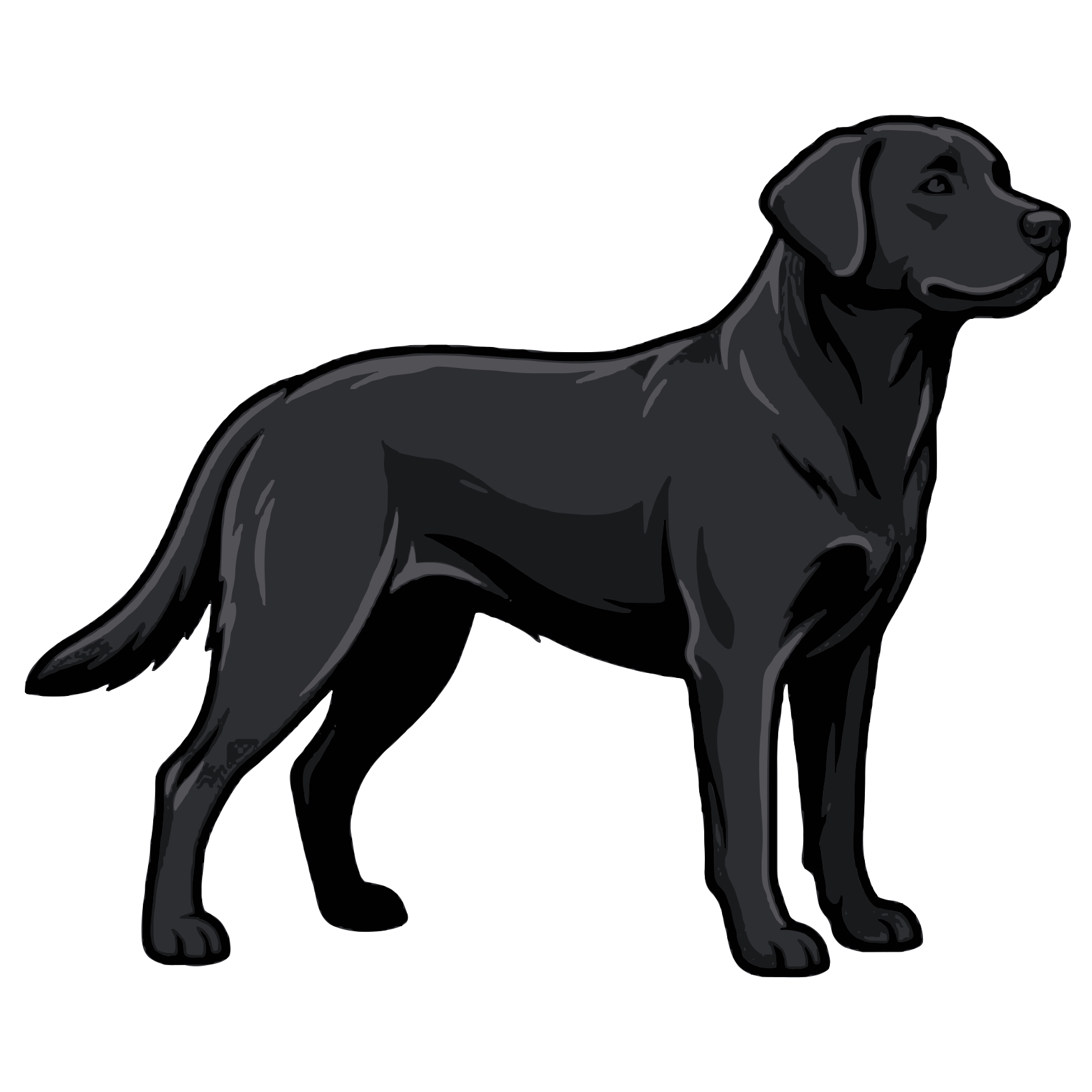
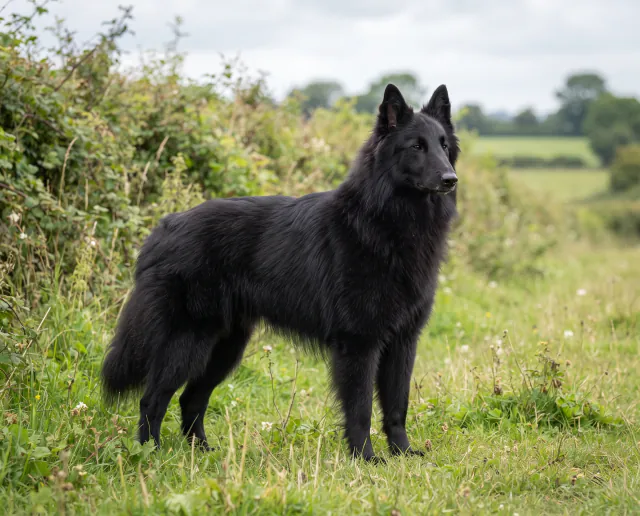
Also known as: Groenendael, Belgian Shepherd Dog (Groenendael), Belgian Sheepdog.
At a glance
Key facts
The essentials to compare before deciding whether this breed fits your home and routine.
- Size
- Large
- Lifespan
- 12 to 14 years
- Energy
- Very high
- Temperament
- Elegant, alert and strongly attached to its own people
- Good with children
- Good with calm children, with early work on herding and noise
- Exercise
- Two hours or more, with training built into the day
- Trainability
- Experienced handler
- Grooming
- Two or three brushes a week, daily through a moult
- Estimated monthly cost, GBP
- £110 to £210 per month
The Groenendael is the solid black, long-coated variety of the Belgian Shepherd, and for most of the twentieth century it was the variety that represented the breed to the public. It takes its name from the village of Groenendaal outside Brussels, where the black long-coated type was fixed by a single breeder working from a pair of black dogs in the 1890s. In North America the same dog is registered simply as the Belgian Sheepdog, which is a common source of confusion when reading pedigrees or overseas advice.
Origin and what it was bred to do
The Belgian Shepherd was organised as one breed in the early 1890s out of the varied farm dogs of Belgium, sorted into varieties by coat rather than by function. The Groenendael’s foundation is unusually well documented, and the narrow start explains both its early consistency of type and why breeders pay close attention to relatedness today.
Its original job was the ordinary one of a Belgian farm dog: moving and holding stock, watching the yard, and being awake to anything unusual. The variety later took to police and army work in Belgium and to search, tracking and competitive obedience more widely, and it remains a strong performer in working trials and scent disciplines rather than a retired show dog.
Coat, colour and grooming
The outer coat is long, straight and abundant with an extremely dense undercoat, of medium harshness, neither silky nor wiry. Males carry a heavier coat with a pronounced neck ruff, leg feathering and a full tail. The colour clause is short: black. Frosting, meaning white or grey hairs on the muzzle, is a normal occurrence in the variety and not a fault, which is worth knowing when looking at an older dog.
A solid black double coat shows dust, sun-bleaching and mats differently from a fawn one, and needs the same two or three thorough brushes a week reaching right down to the undercoat. Behind the ears, through the ruff and behind the elbows are where mats form first. Two heavy moults a year need daily attention for a fortnight, and the shed undercoat from a black dog is conspicuous on light carpet. Do not clip: the coat regulates heat in both directions and the texture often does not return.
Size and build
The Kennel Club gives an ideal 61 to 66 cm (24 to 26 in) for dogs and 56 to 61 cm (22 to 24 in) for bitches, with weight in proportion rather than a range, which usually works out at 20 to 30 kg (44 to 66 lb). The impression is square, upstanding and elegant, with less bone than a German Shepherd and no exaggerated rear angulation. Coat volume makes the dog look considerably heavier than it is.
Temperament and daily life
Groenendael are alert, quick and closely attached to their own household, typically choosing one person to shadow. Reserve towards strangers is normal for the variety; friendliness on demand is not what this dog was bred for. Good early socialisation is what keeps that reserve from tipping into suspicion, and it is worth doing thoroughly and unhurriedly during the first year.
They are watchful and generally vocal, alerting to arrivals and to movement past the property. Teaching a short alert followed by a settle in the first few months is far easier than unpicking a habit later. Left alone for long stretches, most become unhappy and noisy, and this is not a variety that suits a household out all day.
With calm children they are usually good, though a young Groenendael responds to running and shouting the way any herding dog does, by circling and sometimes nipping at heels, so supervision and early redirection are necessary. With other dogs they are typically fine given decent early experience. Cats and small pets need managing.
Exercise and training
Two hours or more a day, and the useful part is the thinking rather than the mileage. A Groenendael walked hard and asked nothing becomes fitter and no calmer. Tracking, scentwork, obedience, agility, trick training and structured games all suit the variety, which enjoys precision work and picks up sequences quickly.
The training temperament is bright and somewhat sensitive. This dog offers behaviour readily, so clear criteria and prompt reinforcement pay off, while heavy-handed correction or unclear expectations produce hesitancy. Build a real off switch deliberately, because the default setting is watchful. Recall needs proper proofing around livestock and traffic before any off-lead freedom.
Health considerations
Twelve to fourteen years is usual. Hip and elbow dysplasia are screened for, with scores for both parents available in writing from a responsible breeder. Inherited eye disease including progressive retinal atrophy is screened for, and epilepsy is recognised across the Belgian varieties, so ask directly about seizures in the line rather than only about tested conditions. Given the variety’s narrow foundation, ask how closely related the parents are as a matter of course.
Costs, home and who this suits
Around £110 to £210 a month covers food for an active large dog, insurance, training or club membership, and grooming equipment. A securely fenced garden matters, and a house with space suits the variety better than a flat.
The Groenendael suits an experienced owner who wants an intelligent, striking, closely bonded dog and is genuinely willing to train and groom one. It is a poor choice for a first-time owner, for a home that is empty all day, or for anyone unprepared for black undercoat on everything twice a year. If the coat work is the obstacle, the short-coated Belgian Malinois is the same dog with an easier coat and more intensity; the fawn Belgian Tervueren is the closest match in every other respect. The Belgian Shepherd varieties overview compares all four.
Sources
- Belgian Shepherd Dog (Groenendael) breed standard, The Kennel Club