At a glance
Key facts
The essentials to compare before deciding whether this breed fits your home and routine.
- Size
- Medium
- Lifespan
- 12 to 14 years
- Energy
- Medium
- Temperament
- Amiable, scent-obsessed, vocal and sociable
- Good with children
- Usually very good with children, being tolerant and unhurried
- Exercise
- About an hour a day of steady walking with sniffing time
- Trainability
- Moderate
- Grooming
- Weekly brushing with moderate shedding, plus ear and skin checks
- Estimated monthly cost, GBP
- £80 to £150 per month
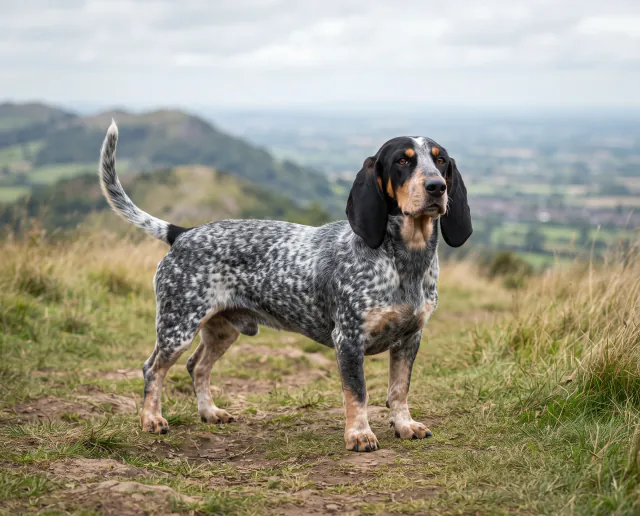
The blue is a trick of the eye. A Basset Bleu de Gascogne is a white dog so densely ticked with black that it reads as slate grey from a few paces, with a black head and saddle and tan points over the eyes, on the cheeks and on the legs. It comes from Gascony in the south west of France, where it is a scaled-down version of the old Grand Bleu de Gascogne, bred to hunt hare and rabbit at a pace a hunter on foot could follow, and it remains a working pack hound in its home country.
Compared with the Basset Hound most British readers know, the Bleu is lighter, longer in the leg, less wrinkled and considerably more athletic. It is a hound first and a pet second, and a happy one where those two roles are allowed to overlap.
Living with the breed
In the house the breed is easy-going, affectionate and content to sleep for much of the day once it has been out. It gets on with other dogs almost without exception, having been bred to live and work in a pack, and it usually does well with children, being tolerant of noise and slow to take offence. Two things need thinking about. The first is the voice: a deep, musical bay used to announce visitors, other dogs, a fox in the garden and the fact that dinner is late, and neighbours in a terrace will hear all of it. The second is company. Pack hounds do not cope well alone, and a Bleu left for a working day will sing and dig its way through the boredom. Cats can be fine where the dog is raised with them; rabbits are a different question for a rabbit hound.
Daily exercise
An hour of walking a day suits most adults, and the quality matters more than the distance. A scent hound needs time with its nose down, so a slow lane with hedges on both sides does more for the dog than a brisk circuit of the park. Off-lead walking is realistic only in enclosed space. Once a Bleu has a line it follows it, deaf to the world, and a hound on a hare across farmland is at risk from roads and from farmers with livestock to protect. Long lines and hired fields are the usual compromise. Puppies have long backs and short legs to protect, so keep walks short, avoid stairs and jumping from cars and let them potter until they are around a year old.
Training and mental work
Hounds bred to work at a distance from people do not have the handler focus of a gundog, and training has to accept that. Reward-based methods work well because the breed is greedy and good-natured; the difficulty is holding attention once a scent arrives. Short sessions, high value food and practice in gradually more distracting places build a dog that comes when called in the garden and most of the time elsewhere. Tracking, scent work classes and mantrailing give the breed exactly the job it was bred for and tire it more than any walk. A hound that has used its nose for half an hour is a hound that sleeps all evening.
Grooming and shedding
The coat is short, dense and close, and a weekly brush with a bristle brush or rubber mitt keeps it in order and lifts the moderate amount of hair the breed sheds through the year, with more in spring and autumn. The long, low-set ears need checking and cleaning every week, since they trap moisture and debris and ear infections are the commonest reason these dogs see a vet. Lips and any loose skin around the muzzle should be kept dry. Nails on a dog that spends its walks on soft verges need regular trimming, and the dewlap and chest collect mud on a wet day, which is most days.
Health and costs
The breed is generally hardy and lives twelve to fourteen years. Because so few exist anywhere, there is little breed-specific health data, and the sensible questions are the general ones for a long-backed, low-set hound: has the breeder had hips scored, have the eyes been examined under the BVA and Kennel Club scheme, and what has appeared in the line. Back problems are a risk in any basset type, so lean condition and sensible handling matter, and a dog that suddenly cries out, refuses stairs or drags a hind foot needs a vet the same day. Ear disease and weight gain are the everyday issues. Monthly costs of about £80 to £150 reflect a medium dog with a good appetite and insurance that should cover spinal problems. The Basset Bleu de Gascogne is listed on the UK Kennel Club’s Imported Breed Register. Litters are rare, most buyers wait a considerable time, and some dogs come in from France. The breed club is the sensible first contact and will know who is planning a litter.
Verdict
The breed suits a household that is home much of the day, enjoys slow walks in the countryside, does not mind a loud dog and has another dog or the time to be constant company. Experienced hound owners and rural families tend to be the best fit.
It is a poor choice for people who want off-lead freedom in open country, for flats with thin walls, or for anyone expecting a quiet, biddable pet that can be left while everyone is at work. The wait for a puppy gives ample time to meet adult dogs and be sure.