At a glance
Key facts
The essentials to compare before deciding whether this breed fits your home and routine.
- Size
- Medium
- Lifespan
- 12 to 14 years
- Energy
- High
- Temperament
- Outgoing, noisy, sociable and stubborn on a line
- Good with children
- Usually very good with children who enjoy a boisterous dog
- Exercise
- An hour to 90 minutes daily with time to follow scent
- Trainability
- Moderate
- Grooming
- Brush several times weekly with hand stripping and moderate shedding
- Estimated monthly cost, GBP
- £85 to £150 per month
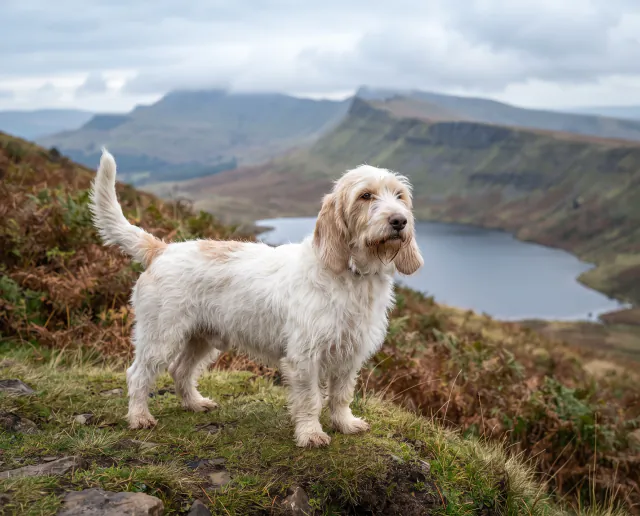
The Grand is the one with the longer back and the longer ears, and the one fewer people have heard of. Both of the rough-coated basset hounds from the Vendée in western France share a name, a coat and a working history of hunting in packs through gorse and scrub, but the Grand Basset Griffon Vendéen was kept for hare, roe deer and even boar, and it needed more size, more reach and more stamina than its Petit cousin. In France it is still very much a hunting dog. In Britain it is a recent arrival with a small following, and most people meeting one for the first time assume it is a large, hairy Basset Hound with an unusual amount of energy.
The two breeds were separated formally only in the twentieth century, which explains why they still look so alike.
Temperament in the home
A GBGV is friendly with almost everyone, dogs included, and has none of the reserve of the sighthounds. It is also loud. The bay is deep and carries, it is used whenever the dog is excited, and a hound bred to keep a pack together across a valley does not see any reason to stop because the neighbours are eating. Company is the other non-negotiable. These are pack animals in the fullest sense and a single dog left alone for long hours will howl, dig and chew its way through the day. Two dogs, or a family where someone is usually about, is the workable arrangement. Children who enjoy a bouncy, tough, cheerful dog get on well, though the enthusiasm can knock over a small one. Cats need to have been there first. Counters and bins are considered fair game.
Exercise and training
Adults need an hour to ninety minutes a day, and a good part of it should be slow, sniffing work on a long line rather than a route march. A tired GBGV is one that has used its nose. Off-lead walking in open country is rarely safe with this breed, since it will follow a line of deer scent over the horizon, and near livestock the risks are legal as well as physical. Hired fields and enclosed woodland are the answer. Puppies have a long back to protect and should be kept to short outings and free play until they are about a year old, with stairs and furniture jumping discouraged. Training works with food, warmth and short sessions. The breed is bright and biddable indoors and hopeless the moment a scent arrives, and the gap between those two states is what training has to bridge. Scent work, tracking and mantrailing suit it exactly. Harsh handling produces a hound that simply switches off.
Coat and grooming
The coat is long, harsh and shaggy over a dense undercoat, with a beard, moustache and eyebrows that give the breed its expression and collect everything the dog walks through. Brushing several times a week with a slicker and a comb keeps the knots at bay, particularly behind the ears, in the armpits and on the trousers, and a dog that comes home wet needs drying rather than leaving. Hand stripping the dead outer coat once or twice a year keeps the texture right and the shedding down; clipping is quicker and softens the coat. Shedding is moderate and the hair is long enough to notice. The pendant ears need weekly cleaning, the beard needs wiping after meals and the feet want checking for grass seeds between the toes through summer.
Health and lifespan
Twelve to fourteen years is a fair expectation. The breed is generally robust, but numbers are small outside France and health data is thin, so the breed club is the best guide to what breeders should be testing. Buyers can reasonably ask for hip scores under the BVA and Kennel Club scheme and for eye examination under the BVA and Kennel Club eye scheme, since persistent pupillary membranes are recognised in the rough-coated Vendée hounds. Ear infections are the everyday problem in any long-eared breed. The long back is a structural weakness if the dog is allowed to get heavy, and keeping a GBGV lean is the single most useful thing an owner can do for its spine and joints. Bloat is a lower risk than in the deep-chested giants but not absent.
Costs and space
Monthly costs sit around £85 to £150, driven by the appetite of a working hound, insurance for a medium breed and either grooming equipment or a groomer’s bill for stripping. Space is less important than boundaries: the breed will live in a modest house provided the garden is fenced to a height and depth that stops a determined digger, and provided the walks are real. Rural or semi-rural homes with tolerant neighbours suit the voice. Litters are few, buyers usually wait, and some dogs are imported from France, so the breed club is the sensible first contact and the place to learn which breeders have plans. Adult GBGVs occasionally come through breed rescue when a family discovers what a pack hound needs.
Verdict
The Grand Basset Griffon Vendéen suits a lively household with time, another dog or someone usually at home, access to safe space for scent work and a tolerance for noise and mud. Experienced hound owners and active rural families are its natural home.
It is the wrong dog for flats, for people out at work all day, for anyone hoping for off-lead reliability in open country or for a house that values silence. The Petit is easier to find and marginally easier to live with, though not by much.