
At a glance
Key facts
The essentials to compare before deciding whether this breed fits your home and routine.
- Size
- Small
- Lifespan
- 11 to 13 years
- Energy
- Medium
- Temperament
- Sociable, sturdy and endlessly keen on human company
- Good with children
- Usually very good with children of all ages
- Exercise
- Two or three brisk walks a day, avoiding midday heat
- Trainability
- Beginner friendly
- Grooming
- A weekly wipe down and moderate shedding for a short coat
- Estimated monthly cost, GBP
- £85 to £150 per month
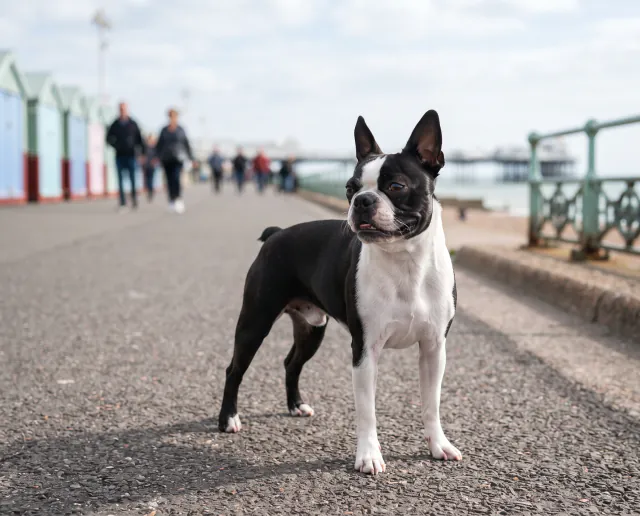
The black and white marking that gives the Boston Terrier its tuxedo nickname is not just decorative, it was specifically written into the breed standard by the Boston area fanciers who developed the breed in the late nineteenth century from bulldog and terrier crosses. Unusually for a breed built partly on bull baiting stock, the temperament that emerged is sociable, gentle and remarkably free of the guarding or fighting instincts that history might suggest. Few breeds shift so completely from working origin to companion role.
What the Boston Terrier kept from that ancestry is a compact, muscular build and a flattened face, and both shape how the breed needs to be kept. It is a sturdy little dog rather than a fragile one, generally more robust than many other short faced breeds, though it shares the same fundamental airway and heat sensitivity issues that come with a shortened muzzle, and prospective owners should understand those limits before falling for the breed’s evident charm.
Living with the breed
Boston Terriers are famously easy going, curious about everyone who visits and generally uninterested in guarding territory. Many are natural comedians, sociable with other dogs and genuinely fond of children, which makes the breed a popular family choice. That sociability cuts both ways, since a Boston Terrier left alone for long stretches can become distressed, and the breed generally prefers company to independence. Bulging, prominent eyes need protecting around boisterous play, sharp corners and long grass with seed heads, since the shallow socket leaves them more exposed than a normal shaped eye. Snoring, snuffling and the occasional dramatic sneeze are simply part of living with the breed and rarely need worrying about unless breathing pattern changes noticeably.
Daily exercise
Two or three shorter walks suit the breed better than one long outing, and summer requires real caution, with exercise shifted to cooler parts of the day and skipped entirely during a heatwave. The breed can overheat faster than its energetic manner suggests, and heavy panting, gagging or reluctance to continue are signs to stop and cool the dog down rather than push toward a target distance. A harness is kinder than a collar given the compromised airway most flat faced breeds share to some degree. Play in the garden, games with other household dogs and short bursts of activity generally suit the breed’s temperament better than sustained aerobic exercise, and most Boston Terriers are satisfied with moderate daily activity rather than a strenuous regime.
Training and mental work
Reward based training suits the breed well, since Boston Terriers are generally eager to please and food motivated, making early lessons in recall, loose lead walking and calm greetings achievable for most owners including first timers. The breed’s sociability can work against recall around other dogs, since an enthusiastic Boston Terrier may prioritise making a new friend over returning to its owner, so a strong recall foundation is worth building before relying on off lead freedom near other dogs. Mental stimulation matters for a breed this alert and curious, and food puzzles, short training games and new environments to explore all help prevent boredom related mischief. Housetraining is generally straightforward with consistency, though as with many small breeds it can take a little longer than with larger dogs.
Grooming and shedding
The short, smooth coat needs only a weekly wipe with a rubber grooming mitt to remove loose hair, and the breed sheds noticeably rather than heavily for most of the year. Facial wrinkles are less pronounced than in some flat faced breeds, but the areas around the nose and any skin folds still benefit from a regular check and clean to prevent soreness. Nails need trimming on a routine schedule, since the breed’s compact build does not naturally wear them down through exercise. Teeth crowd in the short jaw as they do in most brachycephalic breeds, so brushing several times a week helps avoid early dental disease. Bathing on an occasional basis, rather than frequently, keeps the coat’s natural condition intact.
Health and costs
Breathing is the central health consideration for the breed, and while Boston Terriers generally have a less extreme skull shape than some flat faced breeds, brachycephalic obstructive airway syndrome still occurs and can range from mild snoring to a genuine need for corrective surgery. Cataracts and cherry eye, where a gland in the third eyelid prolapses, are both recognised in the breed and worth asking a breeder about alongside any eye health testing they carry out. Patellar luxation and deafness, the latter linked in part to the breed’s piebald colouring, are also documented conditions, and a hearing test on puppies is available and worth requesting. Heat intolerance follows from the shortened muzzle, and owners need genuine discipline about hot weather and warm cars. Typical monthly costs sit around eighty five to one hundred and fifty pounds, though insurance and the possibility of airway or eye treatment can push individual cases well above that.
Verdict
The Boston Terrier suits families and first time owners who want a sociable, adaptable companion, are prepared to manage heat carefully, and can budget for the veterinary considerations that come with any flat faced breed. Its combination of sturdiness and charm makes it more forgiving than some brachycephalic breeds while still asking for the same basic care.
Anyone wanting a dog suited to hot climates, distance running, or long stretches left alone should look elsewhere, and choosing a breeder who prioritises open nostrils and sound eyes over an extreme, flattened look gives a Boston Terrier puppy a considerably better start.