At a glance
Key facts
The essentials to compare before deciding whether this breed fits your home and routine.
- Size
- Medium
- Lifespan
- 12 to 14 years
- Energy
- High
- Temperament
- Alert, biddable and closely bonded to its family
- Good with children
- Usually very good with children it is raised alongside
- Exercise
- About 1 to 2 hours a day plus herding style games
- Trainability
- Moderate
- Grooming
- Weekly brushing throughout, more during seasonal moults
- Estimated monthly cost, GBP
- £95 to £150 per month
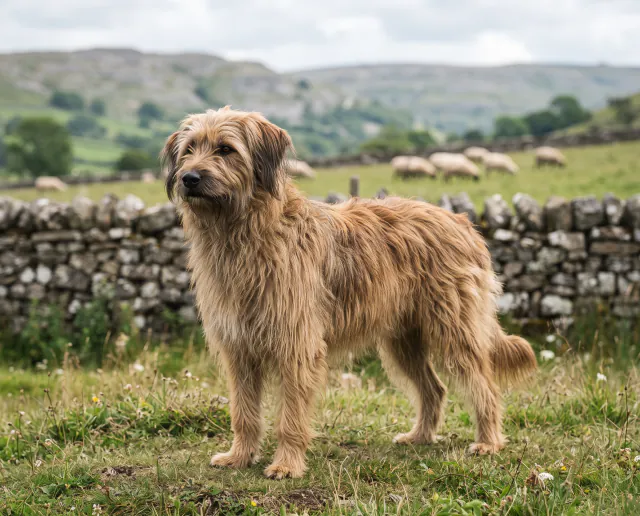
Shepherds working the high pastures above Barcelona needed a dog that could think for itself, hold a flock together on a mountainside and shrug off a night of driving rain. The Gos d’Atura Catala, known in English simply as the Catalan Sheepdog, was that dog for centuries before anyone wrote down a breed standard, and the temperament bred into it for that job has changed remarkably little.
Numbers outside Spain remain small, and most people who own one found the breed by chance, through a holiday in Spain, a working dog forum or a friend already keeping one. Buyers should expect a long wait for a litter and treat the breed club, whether based here or in Catalonia, as the sensible first port of call rather than a general search of classified adverts.
Temperament in the home
Indoors the breed tends to be watchful, affectionate with its own family and reserved with strangers rather than outright suspicious. A Catalan Sheepdog forms a close attachment to its household and likes to know where everyone is, following from room to room in the way herding breeds often do. Barking at the gate or the post van is normal and needs managing from puppyhood, since a dog left to decide for itself what counts as a threat will set the bar low. Most get on well with children they have grown up alongside and with other household dogs, though a strong instinct to herd can show itself as nipping at heels or circling running children, which needs interrupting rather than ignoring. Left alone for long stretches, the breed can become vocal and destructive, since it was never selected to cope with isolation.
Exercise and training
An hour and a half to two hours of varied activity suits an adult well, split across the day rather than delivered in one long outing. The breed thinks its way through problems and gets bored quickly with repetitive road walking, so herding style games, scent work and off lead exploration in safe areas earn their keep. Recall training should start early and continue for life, because a dog bred to range across open hillside will test any boundary it is given. Puppies need shorter, more frequent sessions while their joints and growth plates develop, with jumping and hard surfaces kept to a minimum until they mature. Training itself tends to go smoothly, since the breed is quick to learn and keen to work with a handler it trusts, though harsh methods generally backfire and produce a guarded, uncooperative dog rather than an obedient one.
Coat and grooming
The coat is long, flat or slightly waved and noticeably harsh to the touch, growing thickly around the neck and legs while staying shorter on the head and front of the limbs. It sheds a fair amount through the year with a heavier drop in spring and autumn, and a weekly brush right down to the skin stops the undercoat matting behind the ears, under the elbows and around the tail. Bathing should be occasional, since frequent washing strips the natural oils that help the coat resist wet weather. Owners who let grooming slide for more than a few weeks often find themselves facing matted felt rather than loose tangles, particularly on a dog that spends time outdoors in mud and brambles. Nails, ears and the feathering between the toes deserve a regular check as part of the same routine.
Health and lifespan
The breed is generally considered a robust one, with twelve to fourteen years a realistic span for a dog kept lean and well exercised. Hip evaluation under the British Veterinary Association and Kennel Club scheme is sensible to ask about given the breed’s active, athletic build, even though severe dysplasia is not widely reported as a major problem. Eye checks under the joint BVA and Kennel Club scheme are worth requesting too, since inherited eye conditions turn up across working sheepdog breeds generally. Because so few are bred, a buyer may be dealing with an overseas breeder, in which case seeing health certificates and, where possible, meeting the parents or watching video of them matters more than usual. Keeping weight down protects joints that already work hard on uneven ground.
Costs and space
Monthly costs typically fall between ninety five and one hundred and fifty pounds, covering food, insurance, routine veterinary care and the grooming kit needed to keep a working coat in order, though individual costs vary with insurer and location. There is no professional grooming bill to budget for if an owner learns to manage the coat at home, but the time investment is real. A garden with secure, well maintained fencing suits the breed better than an exposed balcony or a flat, since the dog likes to patrol its own territory and will find weak points in a boundary. A house in a village or on the edge of town, with regular access to open fields or hillside, reflects the kind of environment the breed was shaped for far better than a busy urban street.
Verdict
The Catalan Sheepdog suits an active household prepared to search out a litter, learn a demanding coat routine and give the dog real mental and physical work rather than a lap to sit on. Owners who already understand herding breeds, or who are willing to learn quickly, tend to do well with the temperament underneath the shaggy coat.
It is a poor match for anyone wanting a low maintenance companion, a dog that tolerates long hours alone, or a household without the patience to research a breed that most UK vets and groomers will rarely have met before.