At a glance
Key facts
The essentials to compare before deciding whether this breed fits your home and routine.
- Size
- Large
- Lifespan
- 10 to 13 years
- Energy
- Medium to high
- Temperament
- Loyal, reserved with strangers and strong-minded
- Good with children
- Often good with the family's own children when raised together
- Exercise
- At least 90 minutes a day, ideally including swimming
- Trainability
- Experienced handler
- Grooming
- Weekly brushing with heavy seasonal shedding and no clipping
- Estimated monthly cost, GBP
- £110 to £190 per month
The most common mistake with a Chesapeake Bay Retriever is to treat it as a brown Labrador with a wavy coat. The two breeds share a job and a general outline and almost nothing else. The Chesapeake was developed along the shores of Chesapeake Bay in Maryland and Virginia in the nineteenth century to retrieve ducks from icy tidal water in large numbers, then guard the boat and the day’s bag while the hunter went ashore. That second task is where the temperament comes from. A Labrador greets a stranger as a friend it has not met. A Chesapeake watches and decides.
The breed is uncommon outside North America, with only a handful of litters most years and a small, committed group of breeders, most of whom work their dogs. Buyers usually wait, and a good breeder will ask more questions than they answer, because a Chesapeake in the wrong home is a large, strong, self-assured dog that becomes a problem.
Living with the breed
At home the Chesapeake is devoted to its own people, often with a clear favourite, and affectionate in an undemonstrative way. It is not a dog that greets every visitor with a wagging tail, and most adults are reserved and watchful with strangers, which owners need to manage from puppyhood with broad, positive socialisation so that reserve does not harden into suspicion. Children in the family are generally well treated, and many Chesapeakes are protective of them, but visiting children who shriek and wrestle can be misread, and supervision is the sensible rule. Other dogs are tolerated better when the Chesapeake was raised with them; some adults, particularly males, take a firm line with pushy strangers. The breed is not noisy, though it has a habit of grumbling and groaning when content that alarms people who do not know it.
Daily exercise
Ninety minutes a day of real exercise is the minimum for an adult, and water should feature whenever possible. The breed swims powerfully and happily in conditions that send Labradors back to the car, and a Chesapeake with regular access to a lake, river or cold sea is a far easier dog indoors. Retrieving is the natural outlet, and long retrieves over land and into water tire the dog without wearing it out. Puppies must be protected from overexertion, with short outings and no repeated jumping or long retrieving until the joints have matured at around fourteen months. Near livestock the lead goes on, as with any dog.
Training and mental work
These dogs are highly trainable in the sense that they learn quickly and retain what they learn, and demanding in the sense that they see no reason to repeat something they already know. Drilling the same retrieve twenty times produces a bored Chesapeake that simply stops. Training needs to be varied, fair and consistent, with clear rules held to by everyone in the house, because the breed tests boundaries in a way a Labrador rarely bothers to. Harsh methods backfire, since a Chesapeake pushed hard either pushes back or shuts down, and neither is useful in a dog of this size. Reward-based training with a calm, confident handler suits it best. Early priorities are polite lead walking, a rock-solid recall and a settled, relaxed response to strangers and other dogs.
Grooming and shedding
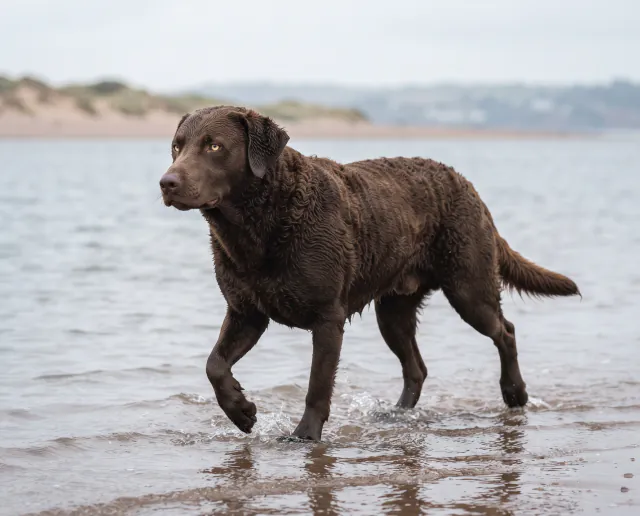
The coat is the breed’s signature, and it is unusual. A dense woolly undercoat sits beneath a short harsh outer coat that is wavy over the neck, shoulders and back, and the whole lot carries natural oil that sheds water and protects the dog in cold seas. Colours run from dark brown through sedge, a reddish shade, to the pale straw tone called deadgrass. Brushing weekly with a firm bristle brush keeps it healthy, and a great deal more comes out during the twice yearly moult, when the undercoat lifts in handfuls. The coat should never be clipped or shampooed often, because both strip the oil and ruin the water resistance that defines the breed; a rinse with clean water after a swim in the sea or a muddy pond is all that is needed most of the time.
Health and costs
Ten to thirteen years is typical. Hip and elbow dysplasia both occur, and breeding stock should be scored under the BVA and Kennel Club schemes, with the results shown rather than described. Progressive retinal atrophy is well documented in the breed, and a DNA test for the prcd form is available, alongside annual examination under the BVA and Kennel Club eye scheme. Tests also exist for exercise induced collapse and degenerative myelopathy, and a careful breeder will have used them. Weight creeps on in a retriever fed as though it were still working, and a lean dog carries far less strain on hips and elbows. Costs sit in the region of £110 to £190 a month across food, insurance, routine veterinary care and minimal grooming, with insurance for a large breed the biggest variable.
Verdict
The Chesapeake Bay Retriever suits an experienced, outdoor household with access to water, a taste for training and a preference for a dog that is loyal rather than indiscriminately friendly. People who work their dogs, or who want a serious partner for hiking, swimming and gundog sport, get the most from it.
First-time owners, families with a constant stream of visiting children, and anyone wanting a Labrador temperament in a different coat should choose a different retriever. The breed’s reserve and strength of mind are the point of it, and they do not go away.