At a glance
Key facts
The essentials to compare before deciding whether this breed fits your home and routine.
- Size
- Large
- Lifespan
- 10 to 12 years
- Energy
- Low to medium
- Temperament
- Placid, dignified, stubborn and quietly affectionate
- Good with children
- Usually very good with children, though heavy enough to flatten a toddler
- Exercise
- Around an hour a day at a steady pace, slower in warm weather
- Trainability
- Moderate
- Grooming
- Brush several times weekly, with heavy shedding and ear cleaning
- Estimated monthly cost, GBP
- £110 to £195 per month
Watch a Clumber Spaniel work a hedge and the pace is the first thing that registers. There is none of the springer’s frantic quartering. The dog moves at a rolling trot, nose down, and pushes through bramble that would turn a lighter spaniel back, bred for men who walked rather than rode. The name comes from Clumber Park, the Dukes of Newcastle’s estate in Nottinghamshire, where the breed was developed in the late eighteenth century as a heavy, silent, close working gundog.
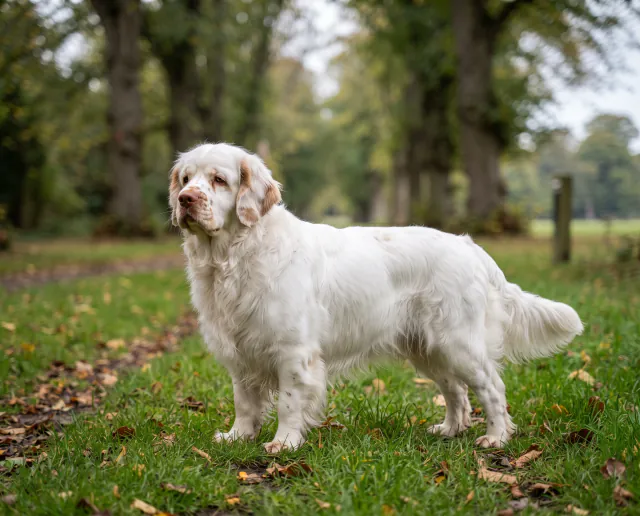
That heritage produced the largest and heaviest of the spaniels. Males can weigh 30 to 34 kilos on legs no longer than a springer’s, with a broad head, deep chest and low slung body that rocks as it walks. It is a lovely dog to live with and a demanding one to keep well, and the Kennel Club lists it among the vulnerable native breeds because so few people now do either.
Suitability
Clumbers are calm, affectionate and rather grand at home, happy to spend the afternoon asleep across a doorway and slow to get excited about anything except food and their own people. They are gentle with children and tolerant of being climbed on, but the sheer weight means a toddler can be knocked flat by a friendly turn of the head. Guests are met with a soft toy or slipper, a habit best channelled into a retrieve. The loose lips drool, and a Clumber that has just drunk will leave a trail across the kitchen. They snore, and the coat sheds white hair in quantity. Strangers get polite reserve, and some can be stubborn to the point of simply lying down when asked to do something they see no reason for. A household wanting a tidy, quiet, biddable dog will find all three lacking.
Exercise
An hour a day of steady walking suits most adults, and a Clumber will cover more ground than its shape suggests, though never quickly. Heat is a real limitation, so summer walks belong at dawn or dusk and a shady garden with water matters. Puppies grow fast and heavy on soft joints, and the usual guidance of short, frequent outings with no stairs, jumping or long walks until at least a year old applies with more force than for a lighter breed. Adults enjoy a working test, a scent trail or a retrieve in the garden, and the breed’s nose is exceptional even by spaniel standards. Off lead, a Clumber will follow a scent at its own pace and can be surprisingly deaf, so recall needs work and the lead goes on near roads and livestock.
Grooming
The coat is dense, straight and silky, mainly white with lemon or orange markings, and sheds heavily throughout the year with two heavier moults. Brushing several times a week with a slicker and a comb, paying attention to the feathering on the legs, chest and belly, keeps most of the hair off the sofa, and the feet and ears need trimming every month or so to stop them collecting mud. The long ears trap moisture and infection, so they should be lifted, checked and cleaned weekly. Eyes need daily attention because the loose lower lids collect debris, and any redness or discharge needs a vet rather than a wipe. Bathing every couple of months keeps the white coat presentable, and proper drying afterwards prevents a damp dog smelling of pond.
Health
Ten to twelve years is typical. Hip dysplasia is a significant issue in a breed of this weight and hip scoring under the BVA and Kennel Club scheme should be asked for on both parents. Eyelid abnormalities, both entropion where the lid rolls inwards and ectropion where it sags outwards, are common and can require surgery, so look at the parents’ eyes and ask about the eye scheme too. A DNA test exists for pyruvate dehydrogenase phosphatase 1 deficiency, an inherited disorder that leaves affected dogs exhausted after mild exercise, and a responsible breeder will produce results for both parents. Back problems occur in a long, heavy dog, and low thyroid function is reported. A Clumber is built to look substantial, and owners routinely let it slide into obesity, which shortens its life and wrecks its joints. Ribs should be easy to feel under the coat.
Choosing and training
Litters are few and most are bred by a small number of experienced enthusiasts, so the breed club is the first call and a wait of many months is normal. Puppies are not cheap and a low price is a warning rather than a bargain. Ask about hip scores, eye examinations and the PDP1 DNA test. Training works best when it takes the dog’s nature into account. Clumbers are willing but slow to respond, and learn well with food, patience and short sessions that end before boredom sets in. Harsh handling produces a dog that sits down and looks at the horizon. Teach a reliable retrieve, a good recall and calm behaviour around food from the start, and introduce grooming, ear cleaning and eye checks in the first weeks.
Verdict
The Clumber suits an owner with space, a tolerance for hair and drool, time for a slow walk twice a day, and an appreciation of a dog that is gentle, humorous and unhurried. Country households, retired shooting people and families with older children who like a big soft dog tend to do well with it.
It is the wrong choice for anyone wanting a clean house, a quick, sharp working dog, a jogging partner or a breed that is easy to find. Those who cannot budget for the veterinary care that a heavy dog with known hip and eye issues may need should look at a lighter spaniel.