
At a glance
Key facts
The essentials to compare before deciding whether this breed fits your home and routine.
- Size
- Medium
- Lifespan
- 12 to 14 years
- Energy
- Medium
- Temperament
- Docile, sensitive, sociable and quietly independent
- Good with children
- Usually very good with children raised alongside a calm dog
- Exercise
- About an hour a day with time to use the nose
- Trainability
- Beginner friendly
- Grooming
- Brush several times weekly with regular trimming of feet and ears, moderate shedding
- Estimated monthly cost, GBP
- £85 to £150 per month
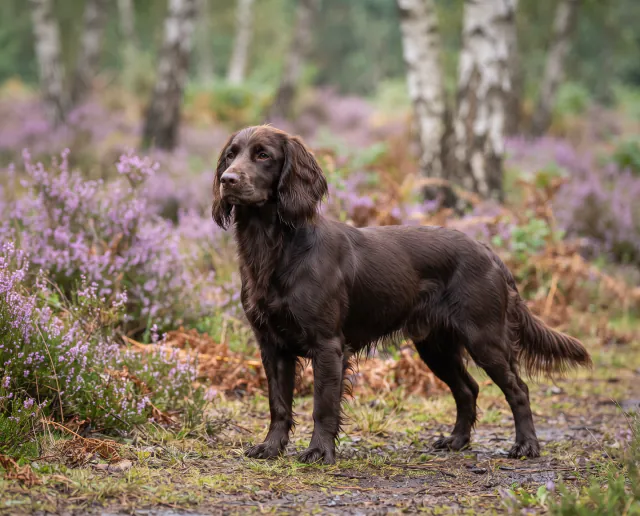
The Field Spaniel very nearly disappeared twice. It was developed in the mid nineteenth century in England as the larger, solid coloured cousin of the cocker, and then the Victorian show ring stretched it into a long, low, heavy caricature that could barely work. By the 1950s it had all but gone. A handful of breeders rebuilt it after the war using English Springer and Cocker outcrosses, and the dog that resulted is well balanced, moderately sized and usable.
The Kennel Club still lists it among the vulnerable native breeds, with very few litters born each year. A Field Spaniel stands around 46 centimetres and weighs 18 to 25 kilos, sitting neatly between the two better known spaniels, and is usually seen in solid liver or black, sometimes roan.
Temperament in the home
Among the spaniels the Field is the calm one. It is affectionate, steady and considerably less busy in the house than a working cocker. Strangers are greeted with mild reserve rather than a wagging assault, and that reserve needs early socialising so it does not tip into shyness. Sensitivity is the trait to understand. A Field Spaniel reads tone of voice acutely and a household with shouting in it, whether at the dog or not, will unsettle one. It is a sociable breed that wants to be part of what is happening, and copes poorly with long stretches alone, sometimes expressing that in barking or destruction. Children and Field Spaniels generally get along well, particularly older ones who can join in with training and walks, and the breed is usually easy with other dogs and cats it has grown up with. Digging and rolling in anything foul are ordinary spaniel habits the Field has too.
Exercise and training
An hour a day is about right for an adult, and quality matters more than distance. These dogs were bred to hunt cover with their nose, and a walk that allows proper investigation of hedgerows and long grass satisfies them far more than the same time on a pavement. Many owners take them to gundog classes or working tests, where the breed’s methodical style and reliable retrieve show well. The hunting drive is real, so recall away from pheasants and rabbits must be proofed early, and a long line in unfenced countryside is sensible until it is. Puppies should have short, gentle outings and no forced running or jumping before the joints have matured. Training is straightforward because the breed is intelligent and wants to cooperate, provided the handler stays calm and rewards generously. Short sessions with food and retrieving, a few times a day, get better results than one long drill. A Field corrected harshly tends to shut down, and rebuilding that confidence takes far longer than losing it.
Coat and grooming
The coat is long, silky and flat or gently waved, with feathering on the chest, belly, legs and ears, and is lighter and more manageable than the American Cocker’s. Brushing two or three times a week with a slicker and a comb keeps it free of tangles, with most attention going to the feathering and behind the ears where mats form first. The hair between the pads and around the ears is trimmed every few weeks to stop it collecting mud and grass seeds, and many owners have a groomer tidy the whole dog two or three times a year. Shedding is moderate and steady rather than seasonal. The ears are long, low set and heavy, and need lifting and checking weekly, with a clean and dry after swimming. A dog that has been through a wet Staffordshire wood in November needs a hose, a towel and somewhere to dry before it is allowed back on the sofa.
Health and lifespan
Twelve to fourteen years is the usual span and the breed is generally sound. Hip dysplasia is recognised and hip scoring under the BVA and Kennel Club scheme is the standard request for both parents. Eye conditions including cataracts and progressive retinal atrophy occur and an annual eye examination under the same scheme should be asked for. Low thyroid function is reported in the breed and shows as weight gain, a poor coat and lethargy. Ear infections are the most frequent problem in everyday life. Weight needs watching in a food motivated dog that spends a lot of the day resting, and the ribs should stay easy to feel through the coat. Because the gene pool is small, ask the breeder how they select matings.
Costs and space
Running costs are moderate, around £85 to £150 a month covering food, insurance, routine veterinary care and periodic grooming, varying with insurer and region. Space is flexible. A Field Spaniel lives well in a house with a garden and can manage in a flat with committed owners who walk it properly, though a secure fence is needed because a spaniel on a scent does not stop at a gap in a hedge. Finding one is the hard part. Litters are rare, breeders are few and a wait of a year is common, so the breed club and its puppy coordinator are the first call. Rescue dogs of the breed are seldom available. A puppy sold quickly, cheaply or without hip scores and eye certificates should ring alarm bells.
Verdict
The Field Spaniel suits a calm household that wants a moderate, affectionate gundog with a manageable coat, is at home a fair amount of the time, and enjoys the idea of doing some training or scent work with its dog.
Anyone wanting a high drive competition dog, a dog that copes with long days alone, or a puppy this month should look elsewhere. Working cockers and springers fill those needs far more readily and in far greater numbers.