At a glance
Key facts
The essentials to compare before deciding whether this breed fits your home and routine.
- Size
- Large
- Lifespan
- 10 to 12 years
- Energy
- High
- Temperament
- Bold, watchful and deeply committed to its family
- Good with children
- Often good with children the dog has grown up alongside
- Exercise
- Well over an hour a day plus regular working tasks
- Trainability
- Experienced handler
- Grooming
- Hand stripping or clipping every six to eight weeks
- Estimated monthly cost, GBP
- £120 to £220 per month
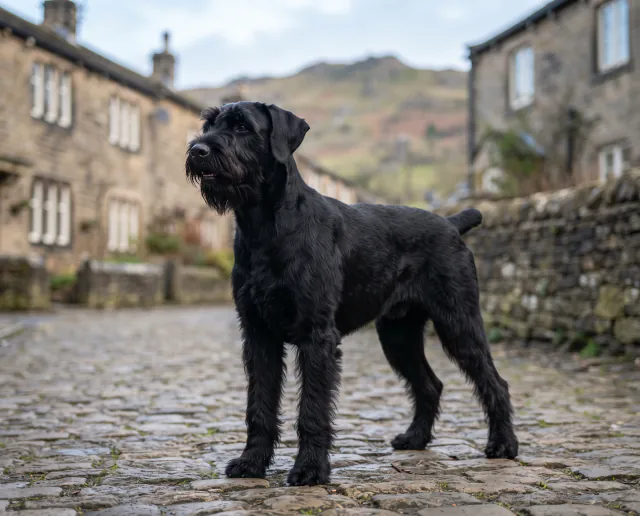
Scale up a Standard Schnauzer by roughly half and add the temperament of a dog bred to drive cattle and guard Bavarian breweries, and the result is a breed that looks similar to its smaller relatives but lives quite differently in a household. The Giant Schnauzer was developed in southern Germany from crosses that likely included drover dogs and possibly early Bouvier types, producing a large, square, powerfully built dog with the wiry coat the whole schnauzer family shares.
Working ability was never bred out to make room for a companion role, and that shows up daily. This is a breed that expects purpose, reads its household closely, and can become a genuine handful when bored, under exercised or left without clear leadership.
Living with the breed
A Giant Schnauzer forms close bonds with its family and tends to be naturally watchful of anyone unfamiliar, which suits its guarding heritage but requires deliberate early socialisation to keep in proportion. Left unchecked, that watchfulness can tip into genuine suspicion or barking at every visitor and passing car. Within the family the breed is typically affectionate and, in many individuals, notably playful for such a serious looking dog. Children who have grown up with the dog usually fare well, though the size and exuberance of an adolescent Giant Schnauzer can knock over a small child without any bad intent behind it. The breed does not thrive on being ignored, and a dog left to its own devices for long stretches tends to find its own outlet, often in the garden or the furniture.
Daily exercise
This is a genuinely demanding breed physically, wanting well over an hour of vigorous exercise most days and doing considerably better with a structured task layered on top of plain walking. Working dog sports such as schutzhund style protection work where properly run, agility, tracking and obedience all suit the temperament, and a Giant Schnauzer given a clear job tends to settle far better indoors than one given only lead walks. Puppies need exercise built up gradually given the size the frame is heading toward, but the adult dog needs both physical output and something to think about, and providing only one leaves the other unspent.
Training and mental work
Consistency matters more than firmness with this breed. Giant Schnauzers are highly intelligent and learn fast, including learning which household members enforce rules and which do not, so training needs to be uniform across everyone in the house from puppyhood. Reward based methods work well and build the cooperative relationship the breed responds to best, whereas heavy handed corrections tend to produce a defensive or stubborn dog. Priorities include calm behaviour with visitors, a reliable recall, and settling on command, since an unoccupied adolescent of this size and confidence can become genuinely difficult to manage. Mental work through scent games, puzzle feeding and structured training sessions is not optional extra credit here, it is close to core maintenance.
Grooming and shedding
The harsh wiry coat needs hand stripping to keep its correct texture and colour, typically every six to eight weeks, though many pet owners opt for clipping instead, which is easier but softens the coat over time and lightens its colour. Between full grooms, the furnishings on the legs, beard and eyebrows need combing several times a week to prevent matting. Shedding itself is low, which suits allergy conscious households, but the grooming workload is high regardless of shedding, and professional grooming costs should be budgeted for from the start unless an owner learns to do the coat work at home. Eyebrows and beard need checking after meals and outdoor work, since both collect debris readily.
Health and costs
Ten to twelve years is typical for the breed. Hip and elbow dysplasia occur often enough in large working breeds that scoring under the BVA and Kennel Club scheme is worth asking any breeder about directly. Autoimmune thyroid disease has been documented in the breed, and toe and nail conditions along with certain eye conditions are also recognised, so an established breeder should be able to speak to what testing their lines carry. Bloat, or gastric dilatation and torsion, is a real risk in deep chested large breeds and owners should learn the warning signs and know where the nearest emergency vet is before it is needed. Costs run high given the size and the coat care, with £120 to £220 a month a reasonable indicative range once food, insurance, veterinary care and regular grooming are all included.
Verdict
The Giant Schnauzer suits an active, experienced owner who wants a genuinely capable working dog, is willing to commit to structured training and regular coat maintenance, and has the space and confidence to manage a large, driven breed through adolescence. Given a job and consistent handling, the dog repays the effort with real loyalty and ability.
Anyone wanting a low maintenance coat, a laid back temperament, or a dog suited to long stretches alone should look elsewhere. Underestimating the working drive behind the handsome bearded face is the most common mistake new owners make with this breed.