
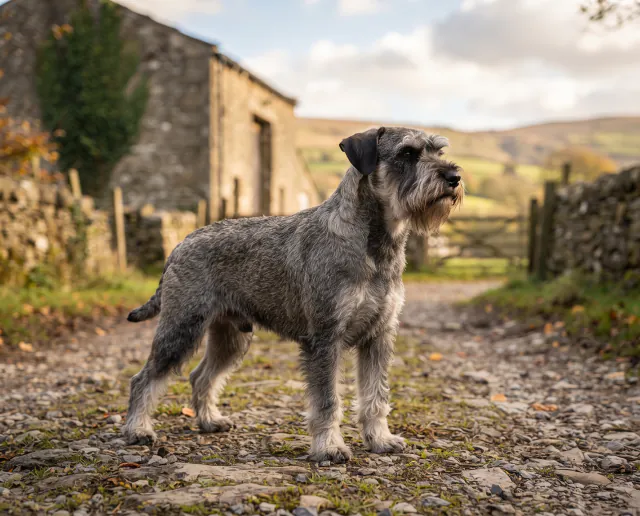
At a glance
Key facts
The essentials to compare before deciding whether this breed fits your home and routine.
- Size
- Medium
- Lifespan
- 13 to 16 years
- Energy
- Medium to high
- Temperament
- Watchful, confident and genuinely protective
- Good with children
- Often good with children raised alongside the dog
- Exercise
- An hour to ninety minutes a day of structured activity
- Trainability
- Moderate
- Grooming
- Hand stripping or clipping with brushing two or three times weekly
- Estimated monthly cost, GBP
- £100 to £170 per month
Ask most people to picture a Schnauzer and they usually describe the Miniature, the size that became a popular pet breed worldwide. The dog properly called simply the Schnauzer, without a qualifying size, came first. German stablemen and tradesmen bred it in the nineteenth century as an all purpose yard dog, ratter and cart guard, a size roughly midway between the diminutive Miniature bred down from it and the substantial Giant bred up from it for driving cattle and guarding breweries.
That original, working sized Schnauzer remains far less common than either relative, which is a shame given how well a genuinely medium sized, weatherproof, watchful dog suits ordinary family life. Standing around forty five to fifty centimetres and weighing up to twenty kilograms, it combines real working substance with a coat and temperament that ask more of an owner than the Miniature’s easier reputation suggests.
Living with the breed
A Standard Schnauzer bonds closely with its family and stays genuinely watchful of anyone unfamiliar, a trait bred in deliberately rather than a fault to correct. Visitors are usually accepted once properly introduced, but a Schnauzer left to make its own decisions about strangers can become overprotective, so consistent socialisation from puppyhood matters more here than in a purely companion breed. Children raised alongside the dog generally do well, since the breed is patient and playful within a household it considers its own, though supervision remains sensible given its size and confidence. The breed prefers company to solitude and can turn to barking or destructiveness if regularly left for full working days without a plan.
Daily exercise
An hour to ninety minutes of genuine activity a day suits an adult, and the breed’s working background shows in how readily it takes to structured tasks over aimless wandering. Carrying, dragging and pulling games, scent work and obedience style training all give it a job to do, which matters more to temperament here than sheer distance covered. Puppies need the usual caution around jumping and hard surfaces while growing, since this is a medium sized dog reaching full size over more than a year. A Schnauzer given structured daily work tends to be noticeably calmer indoors than one given only a walk round the block.
Training and mental work
The breed is intelligent and capable, but its watchful, somewhat independent streak means training benefits from an owner who is calm, consistent and reasonably experienced with assertive dogs, rather than one hoping for effortless obedience from day one. Harsh handling tends to make a Schnauzer more guarded rather than more compliant, while confident, reward based training builds a genuinely biddable adult. Early exposure to a wide range of people, dogs and situations reduces the risk of watchfulness tipping into suspicion of anything unfamiliar. Mental work matters as much as physical exercise, and a Schnauzer given scent games and problem solving toys settles far better than one left simply to patrol the garden.
Grooming and shedding
The wiry double coat needs hand stripping two or three times a year to preserve its harsh texture and correct colour, in the same way as a wire coated terrier. Clipping is common in pet homes and considerably less time consuming, but it softens the coat over time and lightens the colour, a trade off worth understanding before committing to either route. Between full grooms, brushing two or three times a week through the beard, legs and body keeps the coat free of tangles and food debris. Shedding is genuinely low when the coat is properly maintained, which suits households sensitive to loose hair, though the labour behind that low shedding is considerable.
Health and costs
A well kept Standard Schnauzer commonly lives thirteen to sixteen years, longer than many dogs of similar bulk. Hip dysplasia is recognised in the breed, and hip scoring under the BVA and Kennel Club scheme is a fair request of any breeder. Eye conditions are screened for under the equivalent BVA and Kennel Club eye scheme, and a responsible breeder should hold current certificates for both parents. As with many deep chested, active dogs, a sudden bout of restlessness, unproductive retching or visible abdominal swelling is an emergency rather than something to monitor overnight. Typical costs of £100 to £170 a month cover food, insurance and veterinary care, and coat work, whether stripped or clipped, adds a predictable extra most owners come to budget for without complaint.
Verdict
The Schnauzer suits an owner with some previous experience of confident, watchful breeds, space for a genuinely medium sized dog, and a realistic plan for either hand stripping or accepting a softer clipped coat. Families wanting a loyal, protective, trainable dog and willing to invest in early socialisation tend to do well with the breed.
It is a poor match for a first time owner hoping for an easygoing, universally friendly dog, for a household unable to commit to coat maintenance, or for anyone wanting a dog content to ignore every stranger at the door.