
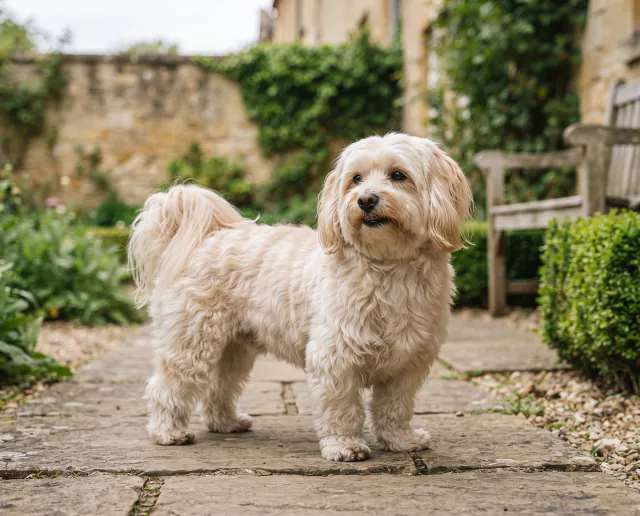
Also known as: Havana Silk Dog.
At a glance
Key facts
The essentials to compare before deciding whether this breed fits your home and routine.
- Size
- Toy
- Lifespan
- 14 to 16 years
- Energy
- Medium
- Temperament
- Sociable, playful and devoted to its household
- Good with children
- Usually very good with children who play gently
- Exercise
- About 45 minutes a day split into two outings plus play
- Trainability
- Beginner friendly
- Grooming
- Daily brushing of a long silky coat, or a shorter clip
- Estimated monthly cost, GBP
- £80 to £140 per month
European traders who called at Cuban ports in the eighteenth and nineteenth centuries often carried small companion dogs as gifts for colonial households, and the line that took root on the island became the Havanese, now recognised as Cuba’s national dog. Havana’s wealthier families kept the breed as a parlour dog for generations, and almost nothing about its build or temperament was ever shaped by outdoor work.
That history explains a lot about living with one today. The Havanese has no herding instinct to redirect, no game bird to point at and no vermin to hunt. What it has instead is a strong pull toward human company, a springy, slightly bouncing gait, and a curled plume of a tail that sits over the back. Most owners describe the breed as constantly present rather than merely friendly, trailing from room to room and settling only once everyone else has.
Suitability
Few toy breeds handle ordinary family chaos as comfortably. Havanese are typically playful with children, unbothered by visitors and rarely possessive over toys or food, though small dogs and boisterous toddlers still need supervising in both directions. They tend to get on with other dogs and often accept cats raised alongside them. The real requirement is company. Bred across centuries purely to be near people, a Havanese left alone for a full working day frequently develops anxious barking or destructive habits, and building tolerance to short absences from puppyhood matters more than any other single piece of training. Flats and small houses suit the breed well, since its exercise needs are modest and its guarding instinct almost nonexistent, though a home with somebody around for a good part of the day gets far more out of it than one that is regularly empty.
Exercise
Around 45 minutes a day, split into two walks with some play worked in, keeps a healthy adult content. The breed is more interested in games, tricks and interaction than in distance covered, and many take readily to agility, flyball or simple obstacle courses set up in a garden. Puppies should be kept off high furniture and discouraged from repeated jumping, since the breed carries a documented risk of patellar luxation and young joints are the most vulnerable. A securely fenced garden is useful but not essential, since most of the breed’s energy is burned indoors through fetch, tug and short training bursts rather than open-country running.
Grooming
Left to grow, the coat is long, silky and free of curl, reaching the ground on some show dogs, and it needs brushing most days to prevent matting behind the ears, under the legs and around the collar line. Many pet owners choose a shorter all-over clip instead, which cuts the grooming to a weekly session and a visit to a groomer every six to eight weeks. Either way the coat sheds very little, making it a reasonable choice for households sensitive to loose hair. Eyes should be checked for the mild staining common to pale coats, and ears, which hang close to the head, benefit from a regular look for wax and odour. Nails on a dog this light grow quickly and need trimming more often than owners expect.
Health
Reputable breeders screen for patellar luxation and will discuss the hip and elbow position of the parents even though the breed’s small size makes serious hip disease less common than in larger dogs. Eye conditions including cataracts occur in the breed, and testing under the BVA and Kennel Club eye scheme is worth asking about. Legg-Calve-Perthes disease, a hip joint condition seen across several small breeds, has been recorded in Havanese and shows up as lameness in a young dog, usually needing surgical treatment. A responsible breeder should be able to talk through the health history of both parents without hesitation, and a puppy that has already had a veterinary check before collection is a good sign. Keeping the dog slim protects joints that carry relatively little natural padding.
Choosing and training
The Havanese Club of the UK and the breed’s Kennel Club page are sensible starting points for anyone hoping to buy from a health tested litter, since demand regularly outpaces the number of registered litters produced each year and waiting lists are common. Avoid anyone offering multiple breeds from one address or unwilling to let a buyer see the puppies with their mother. Training tends to be straightforward, since the breed is quick to learn and strongly motivated by attention and food, though a soft manner works far better than firmness. Early socialisation to a range of noises, surfaces and situations helps prevent the nervous, overly vocal streak that can develop in under-exposed individuals of any small companion breed.
Verdict
The Havanese suits a household that wants a sociable, adaptable small dog and has the time to include it in daily life, whether that is a family home, a couple working from home, or an owner who takes the dog along on errands. Its low shedding and modest space needs make it workable in a flat, and its willingness to learn makes it rewarding for a first-time owner.
It is a poor match for a home left empty for long hours on a regular basis, or for anyone unwilling to commit to either daily brushing or regular trips to a groomer. Buyers drawn by the breed’s popularity should still expect a wait for a puppy from a careful breeder rather than an immediate purchase.