At a glance
Key facts
The essentials to compare before deciding whether this breed fits your home and routine.
- Size
- Medium
- Lifespan
- 12 to 15 years
- Energy
- Medium
- Temperament
- Sociable, expressive and unfailingly pleased to see people
- Good with children
- Usually very good and generally patient with children
- Exercise
- About an hour a day, happily split into shorter walks
- Trainability
- Moderate
- Grooming
- Weekly brushing, with two dramatic seasonal coat drops
- Estimated monthly cost, GBP
- £80 to £150 per month
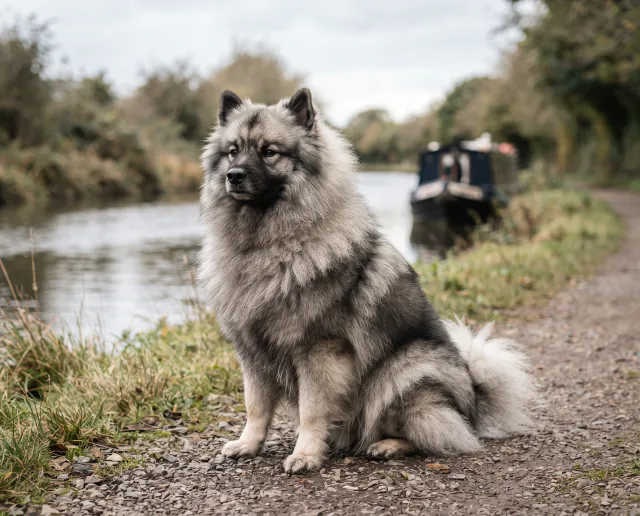
Look closely at a Keeshond’s face and the breed’s nickname explains itself. Dark rings and shading around the eyes give a spectacled, almost human expression, framed by a huge ruff of standing fur that makes the head look larger still. The breed takes its name from Kees, a Dutch political figure of the eighteenth century whose supporters adopted the dog as something of an emblem, and it worked for generations on barges along the canals and rivers of the Netherlands, alerting bargemen to visitors and vermin alike.
That watchdog role left a permanent mark on the temperament, and a Keeshond will announce anything unusual with real enthusiasm, but the breed never developed the guarding edge or territorial aggression seen in some working watchdogs. What survived instead is warmth. This is a spitz breed built around people, happiest in the middle of family life rather than patrolling its own patch alone.
Temperament in the home
Keeshonden are consistently sociable, treating strangers with cheerful interest rather than suspicion once the initial announcement of arrival is over. The breed does well with children, generally patient with the noise and unpredictability of family life, though any dog benefits from supervision with very young children regardless of temperament. Other dogs are rarely a problem, and the breed often does best with company, human or canine, for a good part of the day, since it was not developed for long stretches of solitude and can become genuinely distressed left alone too often. Barking is the trait most likely to catch new owners out. A Keeshond comments on the doorbell, passing dogs, unfamiliar noises and general household activity, and this needs managing from puppyhood rather than accepted as unavoidable.
Exercise and training
An hour a day, split across two or more outings, suits most adults well, and the breed enjoys varied walking more than repetitive routes, taking a keen interest in whatever is going on around it. Puppies need proportionately less, with growth taken into account for a medium sized dog still developing through its first year. Recall tends to be reasonably good once trained, since the breed is people focused rather than independently minded, though the same alertness that makes it watchful can also mean it reacts to distractions with a bark before settling back to the walk. Training generally goes well with reward based, consistent handling, and the breed’s eagerness to be involved makes it a willing participant in obedience work, agility or simple trick training if an owner wants to give the mind something to do beyond the daily walk.
Coat and grooming
The coat is the Keeshond’s defining feature, a dense, harsh, standing outer coat over a thick soft undercoat that gives the breed its characteristic plush, almost lion like ruff and heavily feathered tail. Weekly brushing with a slicker and a metal comb through the ruff, trousers and tail keeps the coat mat free for most of the year. Twice yearly the undercoat blows out dramatically over several weeks, shedding in real quantity, and daily raking during that period is close to necessary if the house is to remain manageable. The coat does not need trimming or clipping to look correct, and clipping it is generally discouraged since it can affect the texture and regrowth. Between the two seasonal drops the breed is a moderate, steady shedder rather than a constant one.
Health and lifespan
Twelve to fifteen years is a fair expectation for the breed, a solid lifespan for a medium sized dog. Hip dysplasia occurs, and BVA and Kennel Club hip scores for both parents are a reasonable thing to ask a breeder for. Patellar luxation affects the knees in some lines. Hyperadrenocorticism, an overactive adrenal gland condition, has been documented in the breed more often than in the general dog population, and any breeder with a long history in Keeshonden should be able to discuss it openly. Heart conditions and a skin condition sometimes described as Keeshond alopecia, affecting coat growth without other illness, are both worth raising with a breeder. Weight management matters given the dense coat can hide early weight gain from a casual glance.
Costs and space
A medium sized home with reasonable outdoor space suits the breed best, partly for exercise and partly because a dog this vocal benefits from some distance from neighbouring windows and doors. Monthly costs typically run between £80 and £150, covering food, insurance and routine veterinary care, with grooming tools and occasional professional bathing during the coat blows as a predictable extra rather than routine expense. The breed is not common in most countries, so puppies from a breeder who health tests and socialises litters properly may involve a wait, and the national breed club is the sensible first point of contact for anyone serious about getting one.
Verdict
The Keeshond suits sociable households wanting an affectionate, people oriented dog that is happy to be part of family life rather than kept at arm’s length, and who can commit to managing a genuinely enthusiastic bark. It also suits owners prepared to be home for much of the day, given the breed’s dislike of long solitude.
Anyone needing a quiet dog for a household with thin walls and close neighbours, or unable to be around for a good part of most days, should consider a calmer or more independent breed instead. Given company and consistent handling, the Keeshond is a warm, loyal and remarkably good natured companion.