At a glance
Key facts
The essentials to compare before deciding whether this breed fits your home and routine.
- Size
- Medium
- Lifespan
- 12 to 15 years
- Energy
- High
- Temperament
- Independent, watchful and fiercely loyal to one family
- Good with children
- Better suited to calm households with older children
- Exercise
- An hour to two hours a day of varied, secure exercise
- Trainability
- Experienced handler
- Grooming
- Weekly brushing with heavy seasonal undercoat loss twice a year
- Estimated monthly cost, GBP
- £85 to £150 per month
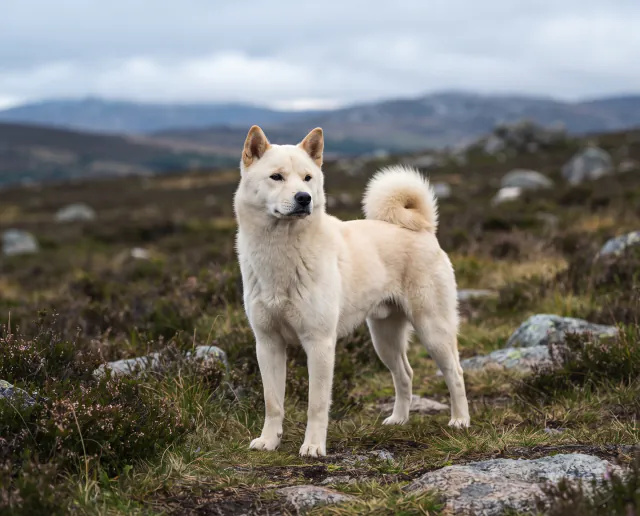
South Korean rescue workers tell the same story often enough that it stops sounding remarkable, a Jindo rehomed with a new family finds its way back to the old one, sometimes over real distance and time. The breed carries protected status in its home country partly because of this fixed, singular loyalty, and the trait shapes everything about keeping one outside Korea. It developed on Jindo Island off the south west coast, working largely without close human direction to hunt small game and see off boar, which bred a dog that thinks for itself rather than waiting on instruction.
That independence, paired with real toughness and a strong prey drive, means the handful of Jindos now appearing outside Korea need an owner who understands primitive breeds, not one drawn only by the fox like head and curled tail. Numbers here remain very small, and most puppies trace back to recent imports.
Suitability
A Jindo usually commits to one household and often one particular person, treating everyone else with polite distance rather than warmth. Visitors are tolerated rather than greeted, and the breed makes an effective watchdog without needing to bark constantly to prove it. Cats, rabbits and other small pets are a genuine risk around a dog bred to catch game, and training does not remove that instinct. Children do best once old enough to respect a dog that dislikes being grabbed or crowded. Fencing has to be properly secure, since a bored Jindo will climb, dig or find a gap a less determined dog would ignore. Rehoming an adult is notoriously hard precisely because of the one family bond, so the decision should be treated as close to permanent from the outset.
Exercise
An adult wants roughly an hour to two hours of varied activity daily, and one left under exercised tends to invent its own entertainment, usually destructive. Off lead freedom in open country is a real gamble, since recall competes directly with hunting instinct and rarely wins outside a securely fenced area. A private, enclosed field gives a safer outlet for a proper run than a public park full of wildlife and other dogs. Scent work, tracking and controlled retrieving suit the working background better than repetitive fetch. Puppies need the same caution over growth as any medium sized dog, built up gradually rather than pushed. Lead discipline near sheep or ground nesting birds matters, since UK countryside law expects dogs under close control around livestock.
Grooming
The double coat suits a cold climate and blows its undercoat twice a year in a shedding event that surprises new owners the first time round. Daily brushing through those weeks clears loose undercoat far faster than letting it drop around the house, and a weekly brush suffices the rest of the year. Jindos are unusually fastidious about their own cleanliness, often compared to cats for how they groom themselves and avoid mess, which keeps bathing to an occasional job rather than a routine one. Nails, ears and teeth need the checks any dog requires.
Health
With such a small and recent UK population, the depth of health data available for long established pedigree breeds simply does not exist yet, and that should be said directly rather than offering false reassurance. Hip and elbow scoring under the BVA and Kennel Club scheme is a fair request of any breeder working with an active, medium sized dog, and general good practice, including keeping the dog lean and reporting any change in gait promptly, applies as it does everywhere. The breed club is better placed than a general search to advise on whatever screening is currently sensible, and that conversation belongs before any deposit changes hands.
Choosing and training
The Kennel Club carries the Korean Jindo on its Imported Breed Register, shown with an Imp suffix in its records, reflecting how recently the breed has arrived here in any number. Litters are genuinely few, waiting lists are ordinary rather than a sign of fashion, and some puppies will be imported directly or bred from recently imported parents. The breed club is a better starting point than an open listings site, since its contacts can speak honestly about availability and the small pool of dogs behind any pedigree. Monthly running costs, typically £85 to £150 covering food, insurance and veterinary care, are unremarkable for a medium sized dog, though insurance quotes for a rare breed can vary more than usual between providers. Early, wide socialisation matters given the breed’s natural wariness, and should start the day a puppy arrives. Training rewards patience far better than correction, since a Jindo that decides handling is unpleasant will simply disengage. Meeting adult dogs gives a far more honest picture than a litter of puppies ever can.
Verdict
The Korean Jindo suits an experienced owner with securely fenced land, no cats or small pets, and a genuine interest in a primitive breed that offers loyalty on its own terms rather than performed affection. Rural and semi rural homes with patience for a slow introduction tend to get the most from the breed.
Anyone wanting a sociable dog that greets every visitor, a reliable off lead companion in open countryside, or a first dog to learn on should look elsewhere, as should households with rabbits, cats or very young children, whatever a puppy’s apparent calmness suggests.