
At a glance
Key facts
The essentials to compare before deciding whether this breed fits your home and routine.
- Size
- Medium
- Lifespan
- 14 to 16 years
- Energy
- Medium to high
- Temperament
- Alert, affectionate, busy and quick to learn
- Good with children
- Usually very good with children who join in scent games
- Exercise
- About an hour a day plus daily scent work
- Trainability
- Beginner friendly
- Grooming
- Professional clipping every eight to ten weeks, with minimal shedding
- Estimated monthly cost, GBP
- £90 to £150 per month
The Lagotto Romagnolo is the only breed with truffle hunting written into its purpose, and that fact colours everything about it. Before that job it was a water retriever in the marshes of Romagna in north-east Italy, and when those marshes were drained in the nineteenth century the dog was redirected to finding truffles in the oak and hazel woods of the region, work it still does. The Kennel Club puts it in the gundog group, but a modern Lagotto is a scenting specialist first and a family dog second, and it needs a job for its nose.
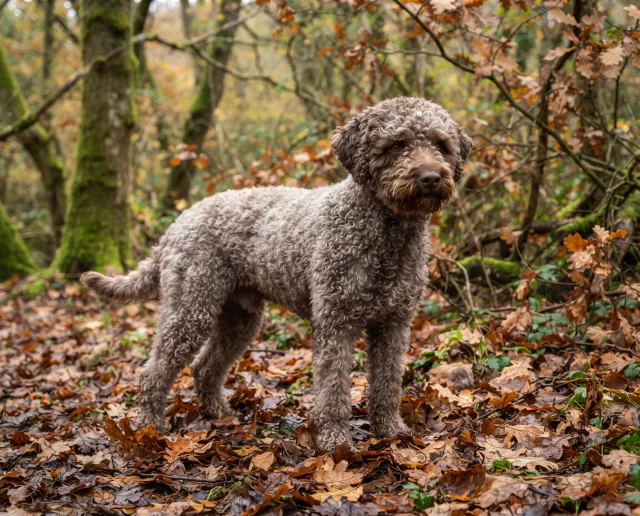
Most people buying one do so for the coat, which is curly, dense and sheds very little, and for a size that fits a normal house. The bit that gets overlooked is the intensity of the dog underneath, a busy, quick, alert animal with a working temperament that does not switch off simply because there are no truffles about.
Temperament in the home
Lagotti are affectionate, attentive and closely bonded to their people, and most are good with children and with other dogs. They are alert without being aggressive, and they bark. A dog bred to tell a truffle hunter it has found something has a voice and uses it, at visitors, at the doorbell and at anything unusual in the garden. Digging is a breed trait, and a Lagotto with nothing to do will excavate a lawn with real commitment. Separation is tolerated reasonably by a mature, exercised dog, though a bored one left all day will find work of its own. Cats are usually fine with early introduction. Guarding runs to noise rather than action.
Exercise and training
An hour of exercise a day is enough physically for an adult, and the breed adapts well to a household walk, but mental work matters more. Ten minutes of scent work, hunting for hidden treats or toys in the garden or the house, tires a Lagotto more than an hour on the lead. Scent detection classes, mantrailing and tracking suit the breed particularly well. Recall is generally good because the dog stays interested in its handler, though a strong scent will hold it. Puppies should have short outings and plenty of gentle exposure to people, dogs and places. Training is quick and easy in the sense that the breed learns fast and likes working; the difficulty is that it learns unwanted things equally fast. Reward-based training from the first week, with clear consistent boundaries, produces an excellent dog. Shouting at a Lagotto achieves nothing except a worried dog.
Coat and grooming
The coat is woolly, dense and curly, with a rough texture and a soft undercoat, and it covers the whole dog including the head, where it forms a fringe over the eyes. It sheds very little, which is why the breed is often suggested for people with allergies, though no dog is reliably hypoallergenic and anyone affected should spend time with adult Lagotti before buying. The coat mats if neglected, especially behind the ears, under the collar and in the armpits, and a puppy coat matting as the adult coat comes through is a common surprise. Clipping every eight to ten weeks, either by a professional groomer or by an owner with clippers and a steady hand, keeps the coat manageable. The breed is traditionally kept short rather than fluffy. Combing between clips, ear checks and a wipe of the beard complete the routine.
Health and lifespan
Fourteen to sixteen years is typical, and the breed is among the longer-lived gundogs. Two DNA tests are important. Lagotto storage disease is an inherited neurological condition that affects coordination and behaviour in young dogs, and a DNA test lets breeders avoid producing it. Benign familial juvenile epilepsy, a form of seizure that appears in puppies and usually resolves, also has a DNA test. Both parents should have results for both. Hip dysplasia occurs, and hip scoring under the BVA and Kennel Club scheme is recommended. Eye testing is also encouraged. Weight is easy to manage in a dog this active, though the curly coat hides a thickening waist and a monthly check with the hands is more reliable than looking. Ear infections are common in a hairy-eared dog that swims.
Costs and space
Running costs in the region of £90 to £150 a month cover food, insurance, routine veterinary care and grooming, with the grooming bill the main driver if a professional does the clipping. Owners who learn to clip at home save considerably. Space is not a problem; a Lagotto fits a flat or a terraced house provided it gets its walks and, more importantly, its scent work. A secure garden is useful and will be dug. The breed is still uncommon outside Italy, with litters limited and buyers frequently waiting, and the breed club is where to start. Some dogs are imported from Italy and other European countries, and buyers of those should see health results from the country of origin. Unregistered litters sold on the coat alone are best avoided.
Verdict
The Lagotto Romagnolo suits an owner who enjoys training, wants a medium-sized dog that sheds little and will put time into scent work every day. Families with older children who join in, and anyone interested in scent detection or tracking, do well with the breed.
It is wrong for a household that wants a quiet, undemanding pet, for anyone who dislikes barking and digging, or for an owner who will not keep up with a coat that needs clipping. The coat is the easy part; the mind underneath is the commitment.