Also known as: Perro de Agua Español.
At a glance
Key facts
The essentials to compare before deciding whether this breed fits your home and routine.
- Size
- Medium
- Lifespan
- 12 to 14 years
- Energy
- High
- Temperament
- Alert, watchful, hard working and devoted to its own people
- Good with children
- Often good with children who respect a herding dog's need for space
- Exercise
- 90 minutes a day of varied work, with swimming and training built in
- Trainability
- Beginner friendly
- Grooming
- Professional clipping once or twice a year, never brushed, with minimal shedding
- Estimated monthly cost, GBP
- £85 to £150 per month
Herding sheep in the morning, retrieving a fisherman’s dropped tackle in the afternoon and guarding the farm at night was a normal day for the dog that became the Spanish Water Dog. It comes from Andalusia, where shepherds and fishermen kept a rustic curly coated dog that did whatever was needed, and it was only standardised in the 1980s. Its arrival in Britain is recent, with UK Kennel Club recognition in the early 2000s, and the breed remains uncommon outside Spain.
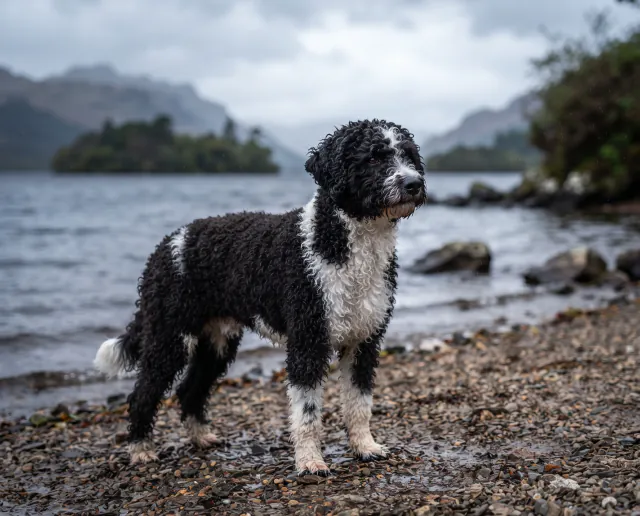
The dog is medium sized, 40 to 50 centimetres at the shoulder and 14 to 22 kilos, with a woolly coat that forms cords when long, and it is almost always cut short once a year and never brushed. It is a working animal in outlook, and households that get on with it treat it as one.
Living with the breed
At home a Spanish Water Dog is affectionate, attentive and thoroughly devoted to its family, following its person from room to room and settling only when it can see them. Guarding is part of the breed. It watches, it announces visitors, and without careful early socialising can become suspicious of strangers, other dogs or anything unfamiliar, so the first four months need a great many people, places, surfaces and sounds. Herding instinct shows in nipping heels and circling running children, which has to be redirected early rather than laughed at. Leaving one alone all day does not work, and a bored Spanish Water Dog barks, digs and dismantles things. Children are usually well accepted where old enough to respect the dog, and other dogs and cats are workable with early introduction. Some are sound sensitive and a few are lead reactive without steady training, traits a good breeder will discuss honestly.
Daily exercise
An adult needs an hour and a half a day of proper exercise, and the breed is happiest when part of it is work. Swimming is bred in, and a river, lake or beach is the best free resource an owner has. Retrieving from water, long walks over rough ground and running with a bike once the dog is mature all suit it. Puppies should have short, frequent outings and no repetitive jumping or long road walks until about a year old, when the joints have finished growing. Off lead these dogs stay close and check back constantly, a legacy of herding, which makes recall easier than in a scent hound, though the drive to chase and gather can put them at risk around sheep, and the lead goes on near livestock. A rainy afternoon on a Scottish loch shore is the day they were made for.
Training and mental work
The breed is among the quickest learners in the gundog group and one of the least tolerant of dull repetition. Sessions should be short, varied and rewarding, with the dog given problems to solve rather than drills to endure. Agility, flyball, working trials, scent work and herding tests all suit it, and a household that takes up one will have a far easier dog than one that does not. Because it thinks for itself, a Spanish Water Dog will test rules and find loopholes, and clarity from the start matters more than firmness. Heavy handling makes it wary and defensive. Mental work at home should be a daily fixture, with food puzzles, hidden objects and trick training all worthwhile. The guarding instinct means neutral behaviour around visitors must be taught, with the dog rewarded for settling on a bed while people come and go.
Grooming and shedding
The coat is a single layer of woolly curls, in black, brown, beige, white or particolour, that grows continuously and forms cords if left alone. It is never brushed or combed, since brushing breaks the curl and produces a frizzy, matted mess. Instead the whole dog is clipped short, usually to one length all over, once or twice a year by a groomer who knows the breed or an owner with clippers and patience, and left to grow out between cuts. Cords, where they form, are separated by hand as they develop and kept from matting at the base. Shedding is minimal, which makes the breed workable for some people who react to dog hair. Bathing is occasional, without rubbing, with the coat squeezed dry rather than towelled. Ears are checked weekly, particularly after swimming, and the hair inside them plucked or trimmed if it traps moisture.
Health and costs
Twelve to fourteen years is typical. Hip dysplasia occurs and hip scoring under the BVA and Kennel Club scheme should be produced for both. Progressive retinal atrophy is recognised and a DNA test for the prcd form is available, so results for both parents are a reasonable request, alongside annual eye examination under the same scheme. Low thyroid function is reported and shows as weight gain, hair loss and lethargy. Because British lines are few, ask the breeder how they source outcrosses. Running costs sit around £85 to £150 a month across food, insurance, veterinary care and clipping. Puppies are more findable than a decade ago but litters remain few and a wait is usual. The breed club keeps a list of expected litters, and some dogs are still imported from Spain.
Verdict
The Spanish Water Dog suits an active, experienced owner who is at home a good deal, enjoys training and dog sports, wants a medium sized dog with a low shedding coat, and has the time and consistency to raise a watchful puppy into a confident adult.
It is the wrong breed for a household that is out all day, for first time owners hoping for an easy dog, or for anyone who wants a relaxed animal that welcomes every stranger. A Labrador, or a cockapoo for the coat, will disappoint fewer of those people.