At a glance
Key facts
The essentials to compare before deciding whether this breed fits your home and routine.
- Size
- Toy
- Lifespan
- 12 to 14 years
- Energy
- High
- Temperament
- Bold, alert and considerably more independent than its size suggests
- Good with children
- Can be good with older children who respect a small dog
- Exercise
- About 45 minutes of proper activity a day in secure ground
- Trainability
- Moderate
- Grooming
- Minimal, an occasional wipe over a short smooth coat
- Estimated monthly cost, GBP
- £70 to £130 per month
The name invites an assumption the breed does not deserve. A Miniature Pinscher is not a shrunken Dobermann, despite the shared colouring and sharp outline, and the two developed separately in Germany with the Pinscher type generally considered the older of the pair, bred originally as a farm dog to control rats and other vermin around stables. Whatever the exact detail of that history, nothing about the modern dog behaves like a toy version of something built for guarding.
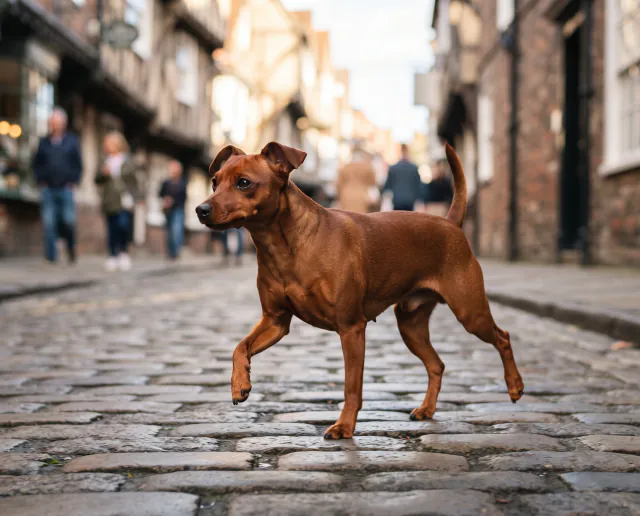
What sets the breed apart on sight is its gait, a distinctive high stepping action at the trot sometimes compared to a hackney pony, driven by strong shoulders and a naturally proud carriage. What sets it apart in the house is attitude. Miniature Pinschers carry themselves with a confidence entirely out of proportion to their five or six kilograms, and most owners quickly learn that the breed considers itself in charge of decisions a smaller, more biddable dog would leave to its handler.
Suitability
This is not a breed that defers easily, and households expecting the soft, endlessly accommodating manner of some other toy dogs are often surprised by how much independence a Miniature Pinscher brings to ordinary situations. Confident handling from day one, without harshness, sets the tone far better than repeated correction, which tends to make the breed more stubborn rather than more compliant. Around children the temperament can be good, but the dog’s size and low tolerance for being handled roughly mean older, sensible children are a considerably better match than toddlers. Other small pets, including cats unfamiliar to the dog, can trigger real prey drive, and introductions need care. The breed tends to manage moderate time alone reasonably well compared with more clingy toy breeds, though it still benefits from company and structure rather than being left to its own devices for long stretches, not least because a bored Miniature Pinscher is a determined escape artist.
Exercise
About 45 minutes of proper activity a day, ideally including some off-lead running in a genuinely secure space, suits the breed’s real energy level far better than a gentle stroll. This is an athletic small dog, and under-exercised individuals often channel the surplus into barking, digging or relentless attempts to get over or under a garden fence. Fencing deserves particular attention, since the breed is a capable climber and jumper for its size and will exploit any gap or low section with real determination. Recall cannot be assumed around distractions, since the same independence that makes the breed characterful also makes it inclined to follow its own agenda once something interesting appears. A harness is often more comfortable than a collar given the breed’s fine boned, arched neck.
Grooming
Coat care is minimal, limited to an occasional wipe with a damp cloth or grooming mitt to lift loose hair, and the short smooth coat sheds relatively little. What the breed does need is warmth in cold weather, since the thin coat offers almost no insulation, and a coat or jumper on winter walks is sensible rather than indulgent. Nails on an active small dog need regular trimming to avoid altering the gait, and teeth benefit from routine brushing given the crowded mouths common to toy breeds. Ears and eyes need no more than the standard periodic check most dogs require.
Health
A well kept Miniature Pinscher commonly reaches twelve to fourteen years. Patellar luxation is the joint condition most frequently discussed in the breed, and a breeder should be able to speak to the soundness of the parent dogs even where formal scoring is uncommon at this size. Legg-Calve-Perthes disease, a hip condition affecting several small breeds in young dogs, has been recorded and shows up as lameness needing prompt veterinary investigation. Progressive retinal atrophy has a recognised DNA test in the breed, and asking whether the parents have been tested is a reasonable question for a buyer to put to a breeder. Given the breed’s confident, sometimes reckless approach to furniture and fences, injury prevention around the home does as much for long term soundness as any health screening.
Choosing and training
Breed numbers are modest in most countries, but litters are found through national breed clubs and assured breeder schemes without the long waits some rarer toy breeds require. A visit to see puppies with their mother, and ideally the father, gives a useful read on temperament before committing. Training benefits from an experienced, patient hand rather than a first attempt at dog ownership approached casually, since the breed is intelligent but selectively cooperative, working hardest when it sees a clear reason to. Priorities worth focusing on early include a reliable recall practised in a secure area, calm behaviour at the front door given the breed’s alertness to visitors, and boundary training reinforced by fencing that a determined small dog genuinely cannot breach.
Verdict
The Miniature Pinscher suits an owner who wants a genuinely characterful, energetic small dog and is prepared to handle its independence with consistency rather than force. Active households, experienced small dog owners and anyone drawn to a breed with real presence tend to get on well with it.
It is a poor match for households expecting a compliant lapdog, homes with insecure boundaries, or families with very young children who cannot yet respect a small dog’s limits. Anyone drawn purely by the resemblance to a Dobermann should look elsewhere for a temperament to match that image, since this breed answers to nobody’s expectations but its own.