At a glance
Key facts
The essentials to compare before deciding whether this breed fits your home and routine.
- Size
- Small
- Lifespan
- 12 to 15 years
- Energy
- Medium
- Temperament
- Independent, watchful and quietly self assured
- Good with children
- Often good with children who respect its independence
- Exercise
- About 30 to 45 minutes a day plus free play at home
- Trainability
- Moderate
- Grooming
- Twice weekly brushing with a heavier seasonal shed
- Estimated monthly cost, GBP
- £70 to £115 per month
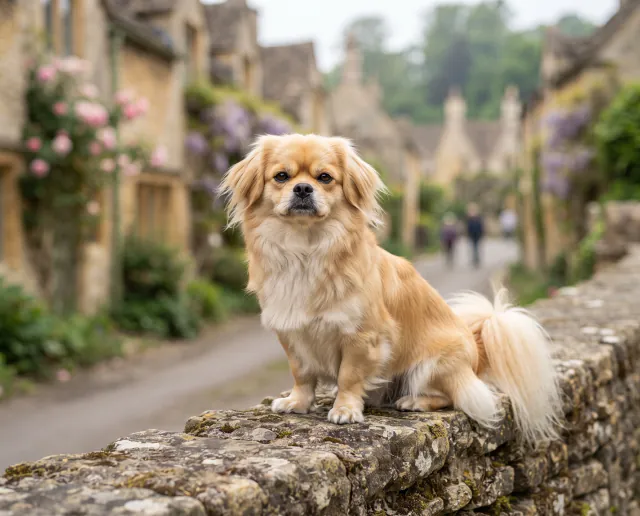
Nothing about the Tibetan Spaniel connects it to the gundog group its name suggests. The breed developed in Tibetan monasteries, where small alert dogs sat on walls and gateways above the main entrances, watching the approach roads and raising the alarm long before a visitor reached the gate. Mastiff type dogs handled the actual guarding at ground level. The little dog on the wall was the early warning system, and that division of labour shaped a breed that is watchful, self possessed and not remotely interested in retrieving anything from water.
Height off the ground still appeals to the modern dog. Owners often find their Tibetan Spaniel perched on the arm of a sofa or the back of an armchair surveying the room, a habit that owes more to monastery walls than to any cat comparison, though the resemblance to a cat’s independence is genuine.
Temperament in the home
A Tibetan Spaniel forms a close bond with its own household while staying reserved with strangers, and that reserve is closer to composure than fear. A dog that climbs onto a lap on its own terms may resist being scooped up and cuddled on someone else’s schedule. Barking at the door comes naturally, a direct echo of the watchdog role, though most individuals settle once satisfied there is no real threat. The breed generally lives well with other dogs and tolerates cats better than most small breeds, having never been bred with a strong prey drive. Children who understand that the dog chooses its own moments for affection get along with it fine, but a toddler who grabs and carries the dog around is likely to meet a firm objection. Left alone for reasonable stretches, most cope better than the clingier toy breeds, a trait that traces back to a working history that did not depend on constant human contact.
Exercise and training
Thirty to forty five minutes of walking most days, split across one or two outings, suits the majority of adults, and the breed is happy to supplement this by investigating the garden or the house at its own pace. It is not a breed that needs a field to run in, though a securely fenced garden lets a confident individual patrol on its own terms. Training benefits from patience rather than repetition, since the same independence that makes the breed a good watchdog also makes it disinclined to perform a command purely because it was asked twice. Food rewards, short sessions and genuine consistency get further than firmness. Recall in open, unfenced spaces should not be assumed, because a dog bred to make its own judgements will sometimes decide against coming straight back.
Coat and grooming
The coat is silky rather than woolly, medium in length, with feathering on the ears, the backs of the legs and a plumed tail carried up over the back. Twice weekly brushing through to the skin keeps mats from forming behind the ears and under the elbows, and a proper coat blow once or twice a year brings noticeably heavier shedding for a couple of weeks. No trimming or clipping is required. Eyes benefit from a wipe if they weep after a windy walk, ears should be checked for wax, and nails need regular attention since a small dog that spends time on soft furnishings wears them down less than one that walks miles on pavement.
Health and lifespan
Twelve to fifteen years is a realistic span for a well kept Tibetan Spaniel, putting it among the longer lived small breeds. Progressive retinal atrophy is documented in the breed, and buyers should ask whether breeding stock has been examined under the British Veterinary Association and Kennel Club eye scheme, or carries a clear DNA result where a test applies. Patellar luxation, where the kneecap slips out of its groove, turns up in many small breeds and this one is no exception, so a vet check of the knees before purchase is sensible. Some individuals carry a mildly shortened muzzle without the pronounced flattening seen in true brachycephalic breeds, and most breathe normally. Weight creeps on easily in a breed that is naturally sedentary indoors, and keeping ribs easily felt matters more than following a feeding chart exactly.
Costs and space
Running costs sit at the lower end for a small dog, typically seventy to a hundred and fifteen pounds a month across food, insurance and routine care, though actual figures vary with region and insurer. Grooming can be managed at home with a decent brush and a little discipline, so there is no mandatory salon bill unless an owner prefers one. Flats and small houses suit the breed well, and a garden is a bonus rather than a requirement, since exercise needs are modest and the dog is not a natural digger or fence tester. A window ledge or a raised bed near a window seems to satisfy the watchdog instinct almost as well as an actual patrol.
Verdict
The Tibetan Spaniel suits owners who want a small, quietly confident dog with a genuine personality of its own, who like the idea of a watchful companion rather than an obedience showpiece, and who can offer modest daily exercise in a flat or a small home. It also suits people who work reasonable hours away from home, since the breed tolerates solitude better than many toy dogs.
It is a poor match for anyone wanting a biddable dog that performs on command, a lap dog available for cuddling whenever the mood takes its owner, or a companion dog that pines badly the moment the house empties. Respect the independence and the breed rewards it with steady, undemanding company for a long span of years.