At a glance
Key facts
The essentials to compare before deciding whether this breed fits your home and routine.
- Size
- Small
- Lifespan
- 12 to 15 years
- Energy
- Low to medium
- Temperament
- Sociable, steady and happiest in company
- Good with children
- Usually very good with gentle, supervised children
- Exercise
- Two short walks a day, roughly 30 to 45 minutes in total
- Trainability
- Moderate
- Grooming
- Daily brushing at full length, or professional clipping every six to eight weeks
- Estimated monthly cost, GBP
- £70 to £130 per month
Small long-coated dogs were kept in Tibetan monasteries and sent as gifts to the Chinese imperial court, where they were bred purely for company and stayed unknown outside palace walls until the twentieth century. A handful brought to Britain in the 1930s founded most of the western population. The breed has never herded, hunted, retrieved or guarded anything, and the temperament reflects it. A Shih Tzu expects to sit at the centre of a household rather than be employed by it, and is generally cheerful about visitors, noise and change.
Two practical facts decide whether ownership works, and neither concerns character. The coat grows continuously and must be managed for life, and the shortened face brings breathing, eye and heat considerations that shape daily routines.
Suitability
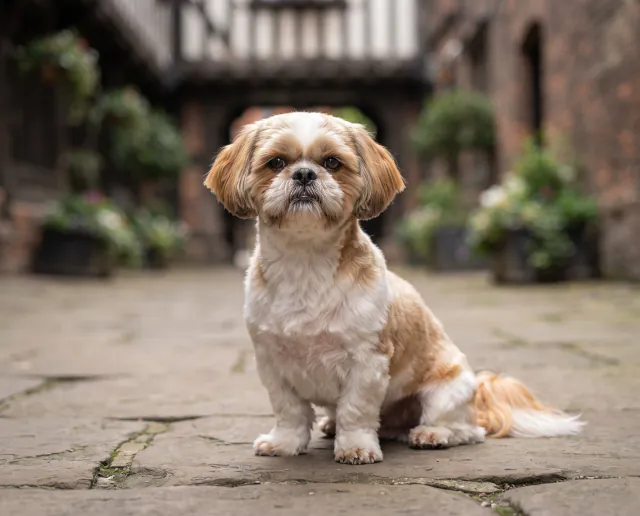
At roughly 4 to 8 kilograms and 20 to 27 centimetres, the breed fits a flat, a small house or a garden-free upper floor, and modest exercise needs suit older owners and people with limited mobility. Shih Tzus are more solidly built than most toy dogs, with heavy bone for their size, and tolerate normal family life better than a fine-boned breed. Prominent eyes and a small frame still mean children need teaching to sit rather than carry, and to leave a sleeping dog alone. Most greet strangers and other dogs pleasantly, guard nothing and settle quickly in new places. Company is the requirement people underestimate, since a breed developed for nothing but companionship copes badly with an empty house all day. Temperature control matters more than square metres, and a hot conservatory or a top-floor room without ventilation is unsuitable. The temperament makes a good first dog. The coat and the flat face are what a novice owner tends to underestimate.
Exercise
Two short walks of fifteen to twenty minutes each keep most adults fit and interested. Judge the individual rather than the clock, watching breathing and recovery and stopping before there is any noisy effort. Warm weather calls for discipline, with outings moved to early morning and late evening and dropped on hot days, since a shortened airway cools a dog inefficiently and heatstroke is an emergency. A harness spreads pressure better than a collar. Much of the useful activity happens indoors, where food puzzles, hide and seek and brief training sessions tire the dog without physical strain. Keeping a Shih Tzu slim matters, because surplus weight loads both the airway and a long back.
Grooming
This is the defining commitment. The double coat grows continuously and will reach the floor if allowed, requiring daily brushing in sections down to the skin plus a topknot to lift hair from the eyes. Few pet owners sustain that, and most keep the dog in a short trim refreshed by a professional groomer every six to eight weeks, which belongs in the monthly budget from the outset. The face needs daily attention whatever the coat length, as food collects in the beard, tear staining is common and hair can rub the eye surface. Heavy, hairy drop ears restrict airflow, so any smell or head shaking warrants a veterinary appointment. Early practice at being turned over and combed pays for itself many times.
Health
Most well-kept Shih Tzus reach twelve to fifteen years. Breathing comes first. The Shih Tzu is brachycephalic, less extreme than a Pug but affected in the same way, and narrowed nostrils or excess soft tissue restrict airflow in many individuals. Snoring, noisy breathing at rest, retching and disturbed sleep all justify veterinary assessment, and surgery improves some dogs considerably. Arranging for a vet to check a puppy’s nostrils and listen to it breathe before purchase is sensible, and a good breeder will not object. Eyes are shallow-set and exposed, so ulcers, dry eye and injury are common, and squinting, cloudiness or sudden discharge needs an appointment the same day. Crowded jaws mean dental disease arrives early without daily tooth brushing. Kneecap luxation, disc problems in a long back and an inherited kidney condition are recognised in the breed and worth raising with a breeder. Monthly costs of roughly £70 to £130 are indicative only, with professional grooming the item separating this breed from other small dogs, and insurance, food and veterinary fees varying by region.
Choosing and training
Ignore anyone advertising imperial, teacup or miniature versions, which are marketing terms rather than recognised types, and smaller size brings more problems. Meet the mother, listen to her breathe at rest, and look for an open nostril and a visible muzzle rather than the flattest face in the litter. Ask what eye and kidney problems have appeared in the line. Rescue organisations regularly have adults available, often surrendered over grooming costs, which removes much of the guesswork. Training begins with handling, since a dog brushed, bathed, trimmed and examined constantly needs to find all of it unremarkable. Food motivates most individuals well, and a reliable settle and short periods alone are the practical priorities. House training is often slow, helped by a covered spot outdoors, because many object strongly to rain.
Verdict
The Shih Tzu suits a household home for much of the day that wants an affectionate, undemanding companion and accepts either daily brushing or a standing grooming appointment. Older owners, flat dwellers and families with gentle children often find the breed close to ideal.
Nobody expecting a small dog to mean small effort should take one on, nor should a household whose rooms get uncomfortably hot in summer, nor an owner unwilling to budget for coat care and possible airway or eye treatment. Choose a puppy for the openness of its face rather than the flatness.