
At a glance
Key facts
The essentials to compare before deciding whether this breed fits your home and routine.
- Size
- Small
- Lifespan
- 12 to 15 years
- Energy
- Medium
- Temperament
- Watchful, independent and reserved with strangers
- Good with children
- Better suited to older children who respect the dog
- Exercise
- About 45 minutes a day split into two shorter walks
- Trainability
- Moderate
- Grooming
- Daily brushing or regular professional clipping, heavy coat upkeep
- Estimated monthly cost, GBP
- £75 to £140 per month
In Tibetan monasteries and noble households, the Lhasa Apso worked as an indoor sentinel, using sharp hearing and a readiness to bark to alert the household, and often the far larger mastiff type dogs kept outside, to anyone approaching. The breed takes its name from the city of Lhasa and developed above the tree line, where a heavy coat and a naturally suspicious temperament toward strangers were useful qualities rather than faults to train out. None of that history involved working alongside a handler the way a gundog or collie does, and the result is a small dog with genuine independence of mind.
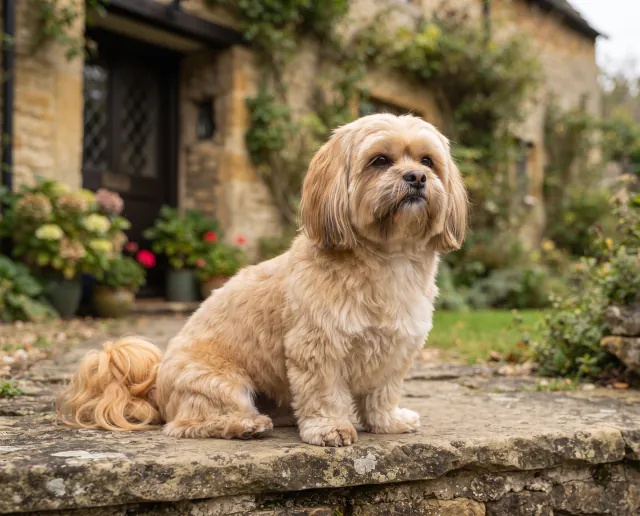
A Lhasa Apso today still carries that watchful, self contained character largely intact. It bonds closely with its own household while staying reserved toward everyone else, and rarely behaves like the ornamental lapdog its coat suggests from a distance. Owners drawn in purely by appearance are often surprised by the stubbornness that comes with it.
Temperament in the home
The breed is confident, opinionated and not automatically obedient, which surprises people expecting a compliant small companion. A Lhasa Apso will defend a favourite chair or a spot on a lap with more determination than its size implies, and any resource guarding around food or toys is worth addressing early rather than laughing off in a puppy. Strangers are usually met with cool assessment rather than enthusiasm, which makes the breed a genuinely useful early warning system, if not a sociable greeter. Children who understand the dog is not a toy generally get on well with an adult, but toddlers and a small dog with little tolerance for being manhandled need constant supervision together. Long stretches alone are usually tolerated better than in more clingy breeds, though every individual varies.
Exercise and training
Physical needs are modest. Two shortish walks a day, perhaps forty five minutes between them, cover most adults, well short of what a working terrier or spitz would need. Mental stimulation matters more than distance, since a bored Lhasa Apso finds its own amusement, often in the form of barking at very little. Training benefits from starting early and staying consistent, because a Lhasa Apso that decides a cue is optional will treat it that way indefinitely. Food rewards and short, genuinely enjoyable sessions beat repetition for its own sake. Recall in open spaces should never be assumed, since the same self reliant nature that suits the breed to time alone also makes it entirely capable of deciding a walk is over on its own terms.
Coat and grooming
The adult coat is long, straight, heavy and harsh to the touch rather than fine or silky, and it grows continuously without a strong seasonal moult, keeping loose hair around the house relatively light. Maintaining it is another matter. Daily attention with a pin brush and comb, working down to the skin, prevents mats forming behind the ears, under the arms and around the hind legs, and a coat left even a few days can felt into knots that need cutting out. Many pet owners choose a shorter, practical clip rather than the full show coat, a reasonable trade for a household without time for daily grooming. Eyes need a wipe to keep hair and discharge from irritating the surface, and the fall over the face should be tied up or trimmed to keep vision clear.
Health and lifespan
A well kept Lhasa Apso commonly reaches twelve to fifteen years, among the better lifespans for a small breed. Eye problems deserve the closest attention, including progressive retinal atrophy, for which a DNA test exists, along with dry eye and inturned eyelids that can need surgical correction. A hereditary kidney condition affecting young dogs is recognised in the breed, so any unexplained increase in thirst or urination in a young dog deserves prompt veterinary attention rather than being put down to a phase. Patellar luxation, where the kneecap slips from its groove, occurs across small breeds and is worth asking a breeder about. Keeping the dog at a healthy weight protects the joints, and dental care matters in a mouth this small, where crowded teeth gather tartar quickly.
Costs and space
Running costs sit in a moderate band for a small dog, typically £75 to £140 a month, though insurance and veterinary fees for any small dog shift considerably between postcodes and providers. Professional grooming every six to eight weeks is the realistic ongoing cost if the coat is kept long, and it can be avoided by learning a shorter clip at home instead. Space is rarely an issue, since the breed suits a flat as comfortably as anywhere larger, provided the barking that comes naturally with a watchful temperament is manageable for neighbours.
Verdict
The Lhasa Apso suits an owner who wants a small, alert, characterful dog rather than a compliant lapdog, who has time for proper coat care or a sensible clipping routine, and who does not mind a watchdog’s occasional bark. Older households and people working from home tend to suit the breed well.
It is a poor match for a home wanting a sociable dog that welcomes every stranger, for families with very young children who cannot yet respect a small dog’s boundaries, or for anyone unwilling to either groom daily or pay for regular clipping.