At a glance
Key facts
The essentials to compare before deciding whether this breed fits your home and routine.
- Size
- Medium
- Lifespan
- 12 to 15 years
- Energy
- Medium
- Temperament
- Loyal, sensitive and quietly determined
- Good with children
- Usually very good with children raised alongside it
- Exercise
- About 45 minutes to an hour a day, varied in nature
- Trainability
- Moderate
- Grooming
- Daily brushing of a long double coat, or regular clipping
- Estimated monthly cost, GBP
- £90 to £150 per month
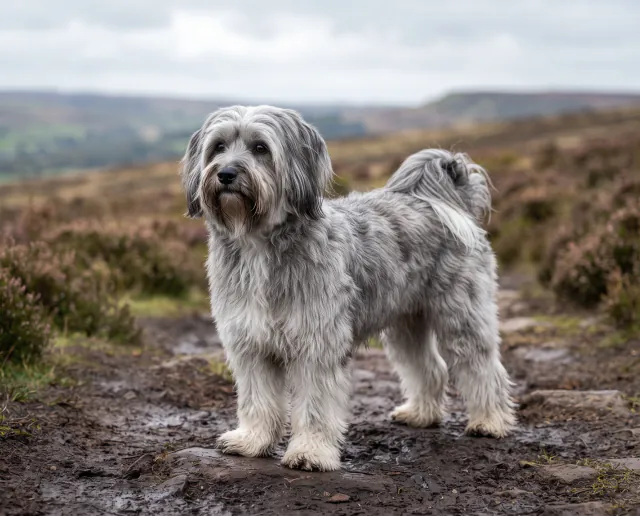
The name is a hangover from early European visitors who saw a medium sized shaggy dog and reached for the nearest familiar category. There is no terrier work in the Tibetan Terrier’s history and no instinct for going to ground. Monasteries and homesteads across the Tibetan plateau kept the breed as an all purpose companion and occasional herding help, valued for its hardiness in a landscape of deep snow, thin air and enormous temperature swings. The feet tell the real story. Broad, flat and covered in hair between the pads, they work like natural snowshoes, spreading the dog’s weight across soft snow rather than sinking into it.
That practical build sits underneath a coat that now gets most of the attention. Long, profuse and double layered, it was originally functional insulation rather than a show feature, though modern owners have to manage it as if it were both.
Living with the breed
Tibetan Terriers form strong attachments to their families and are generally affectionate, sensitive to mood and reliably good with children who have been taught ordinary respect for a dog. Wariness with strangers is common and usually settles once the dog has had a chance to look someone over, so early exposure to visitors, other dogs and normal household noise matters more than it might for a naturally outgoing breed. Some individuals bark to announce visitors or unfamiliar sounds outside, a trait with clear roots in a working life spent alert to changes on isolated ground. Separation is tolerated reasonably well once a dog is settled into a routine, though a puppy left alone too soon can develop habits that are hard to shift later. The breed gets on with other dogs and often lives comfortably alongside cats raised in the same household.
Daily exercise
Something in the region of forty five minutes to an hour most days keeps an adult content, and the breed enjoys variety over repetition, doing well with a mixture of lead walks, off lead time in a secure area and scrambling over uneven ground where it is allowed. The build that suits snow also suits British hills, moorland paths and muddy fields, and a Tibetan Terrier rarely objects to poor weather. Puppies should have exercise built up gradually rather than taken on long walks too young, in line with general guidance for a medium sized, moderately boned breed. Off lead reliability is generally good once recall is established, though the coat picks up a remarkable quantity of mud, burrs and standing water on the way round.
Training and mental work
The breed is intelligent and capable of learning quickly, but a streak of independent judgement means training goes further with patience and reward than with repetition or firmness. Early socialisation, calm handling and consistent house rules from puppyhood head off the wariness with strangers turning into anything more pronounced. Tibetan Terriers do well with scent games, simple agility and problem solving toys, and many take to trick training with obvious enjoyment once they see the point of a session. Housetraining can take slightly longer than in some breeds and rewards a consistent routine over an impatient one.
Grooming and shedding
This is the section that decides whether the breed suits a household. The coat is long, straight or slightly waved, double layered and grows continuously rather than shedding out seasonally in the way many double coated breeds do, which keeps loose hair around the home relatively low but makes daily brushing through to the skin essential to prevent matting. Owners who cannot commit to that routine should have the coat clipped short several times a year, a practical option that many pet owners choose without any loss to the dog’s welfare. Bathing needs to be thorough and drying complete, since a damp undercoat left to dry naturally can mat and hold moisture against the skin. Hair around the eyes needs regular attention to keep vision clear, and feet benefit from a trim between the pads in wet British winters.
Health and costs
DNA testing has become standard practice in the breed for several inherited conditions. Progressive rod cone degeneration, a form of progressive retinal atrophy, has a specific DNA test that breeders should use on both parents. Canine ceroid lipofuscinosis, a neurodegenerative condition abbreviated to NCL, is also tested for by DNA, and lens luxation, where the lens of the eye slips from its normal position, has its own test in related breeds and is worth asking about. Hip scoring under the British Veterinary Association and Kennel Club scheme is sensible given the breed’s active build. A twelve to fifteen year lifespan is typical when these conditions are screened for. Monthly costs of ninety to a hundred and fifty pounds are a reasonable guide, though professional grooming, if chosen over home care, adds a predictable recurring expense on top of food, insurance and routine veterinary bills.
Verdict
The Tibetan Terrier suits an active household prepared to commit to daily coat care, wants a dog with genuine stamina for hill walking and rough ground, and values a breed that bonds closely without becoming demanding. Families with children who already know how to behave around a dog often do very well with the breed.
It is the wrong choice for anyone hoping a long coat will look after itself, or for a household that cannot manage the daily brushing a full coat demands. Choosing the clipped alternative solves the grooming problem but should be a deliberate decision made before the puppy comes home, not a fix reached for once the coat has already matted.