
At a glance
Key facts
The essentials to compare before deciding whether this breed fits your home and routine.
- Size
- Large
- Lifespan
- 13 to 15 years
- Energy
- Medium
- Temperament
- Calm, watchful and quietly devoted to its family
- Good with children
- Usually very good and gentle within its family
- Exercise
- About 45 minutes to an hour of steady walking a day
- Trainability
- Moderate
- Grooming
- Intensive cord formation as a puppy, then occasional separating by hand
- Estimated monthly cost, GBP
- £120 to £220 per month
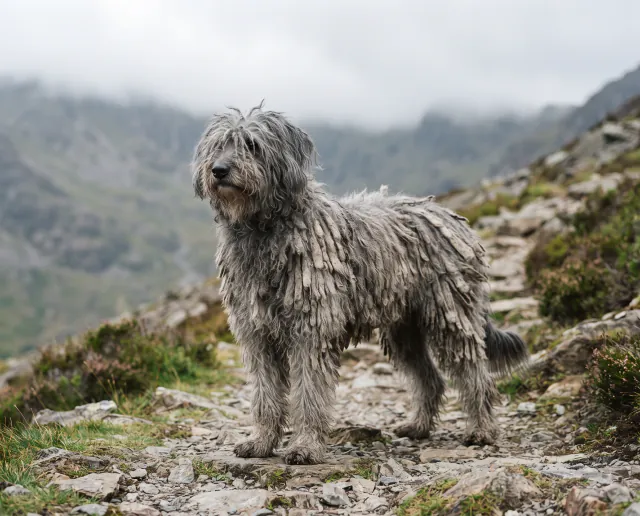
Most dog coats are designed to be brushed. The Bergamasco’s is designed to felt, three distinct types of hair, a fine woolly undercoat, a longer goat like layer and a coarse outer layer, that mat together deliberately from around a year old into flat, matted flocks that hang from the body like a natural coat of chain mail. Shepherds in the mountains above Bergamo in northern Italy bred the dog this way on purpose, since a felted coat kept the cold and wet off a dog living outdoors with the flock for weeks at a time.
The breed is calm, watchful and famously undemonstrative for a herding dog, more inclined to observe a situation from a slight distance than to leap in. It remains rare outside Italy, and the UK Kennel Club currently lists it on its Imported Breed Register. Litters are few, most registered dogs have some imported ancestry, and anyone wanting one should expect the search itself to take time.
Living with the breed
A Bergamasco settles into family life with a quiet, steady presence rather than the bounce and chatter of many herding breeds. Most are affectionate with their own household and reserved rather than hostile with strangers, watching new arrivals carefully before deciding whether to relax. The breed’s herding origins show up as a mild instinct to gather and position family members rather than a strong prey drive, and most Bergamasco get on calmly with children, other dogs and household cats given a sensible introduction. Left alone reasonably, the breed copes better than many working types, though it still values being near its people rather than shut away in another room. The felted coat, while low maintenance in the conventional sense, is a genuine talking point and a considerable one to explain to anyone unfamiliar with the breed.
Daily exercise
Forty five minutes to an hour of steady activity most days suits the typical adult well, since this is a working dog built for endurance at a measured pace across mountain terrain rather than for short bursts of speed. A Bergamasco is content with purposeful walking, gentle hikes and time spent simply present while an owner works outdoors, and the breed does not generally demand the constant high intensity activity that some herding types need to stay settled. Puppies should still be given the same care around growth and joint development as any medium to large breed, with exercise increased gradually rather than pushed early.
Training and mental work
Independence bred over centuries of working at a distance from a shepherd shows up as a dog that thinks things through rather than reacting instantly to commands, and owners used to more biddable breeds sometimes read this as stubbornness. Patient, reward based training that respects the dog’s own pace tends to succeed far better than repetition or pressure. The breed is intelligent and observant, and simple jobs around the house, carrying items, settling on command in different rooms, or basic scent work, suit its temperament well. Socialisation from puppyhood matters, since a naturally watchful breed needs early, positive exposure to a wide range of people and situations to avoid becoming overly guarded as an adult.
Grooming and shedding
The coat’s felting process needs guidance rather than active brushing, since brushing in the conventional sense actually works against the coat once flocks begin forming, usually from around ten months to a year old. Owners typically separate the developing mats by hand into even, finger width sections so they form flat cords rather than one solid matted sheet, a process that takes time in the first eighteen months but very little maintenance afterwards. Bathing is infrequent and drying takes a long time given the thickness of a mature coat, so a warm, well ventilated space matters after a wash. Shedding itself is genuinely low, since loose hair is trapped within the flocks rather than falling around the house, which is one of the more surprising practical advantages of an otherwise unusual coat.
Health and costs
Thirteen to fifteen years is a realistic expectation, a good lifespan for a dog of this size, and the breed is generally considered a hardy one with relatively few widely documented inherited conditions. Hip dysplasia is worth screening for through the BVA and Kennel Club hip scheme given the breed’s size, and any UK litter should come from parents scored under that programme. Because the breed remains rare, buyers should treat any specific health claim with caution and rely on the breed club, which can also advise on the small number of importing routes typically used to bring new bloodlines into the country. Costs run toward the higher end for a large breed, driven partly by the scarcity of vets experienced with the coat and partly by the limited insurance options for an uncommon breed, both worth investigating before committing to a puppy.
Verdict
The Bergamasco suits a patient owner drawn to an unusual, low shedding coat, comfortable with a calm rather than bouncy temperament, and willing to go through a breed club and accept a wait for a puppy.
It is not the right choice for anyone wanting a common, easily sourced breed, a dog with conventional grooming needs, or an owner unwilling to commit real time to the coat during its first two years.