
At a glance
Key facts
The essentials to compare before deciding whether this breed fits your home and routine.
- Size
- Large
- Lifespan
- 10 to 12 years
- Energy
- Medium
- Temperament
- Good-humoured, sociable and physically boisterous
- Good with children
- Usually very good, though big enough to knock a toddler over
- Exercise
- Around 90 minutes a day, split into two or more walks
- Trainability
- Moderate
- Grooming
- Brush several times weekly, with heavy shedding and professional clipping
- Estimated monthly cost, GBP
- £110 to £200 per month
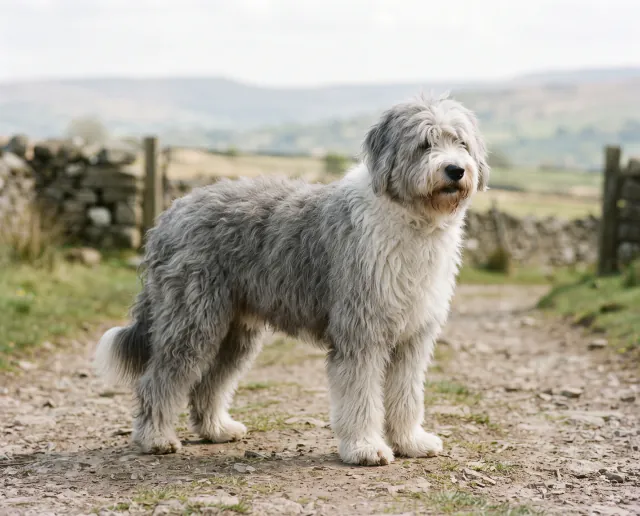
For a generation of British households the Old English Sheepdog is the paint advertisement dog, a grey and white shape with hair falling over its eyes. That image has done the breed few favours. Underneath the coat sits a large, powerful drover’s dog from the west of England, bred to move cattle and sheep along roads towards market and to keep working in bad weather. The shortened tail behind the old nickname bobtail came from docking, which is now restricted in the UK, so puppies born there normally have a full tail and use it enthusiastically.
Two things surprise most new owners. The first is the sheer quantity of dog, since a well-grown male carries the weight of an adult Labrador with a great deal more coat on top and no real understanding of where his back end is. The second is that the coat is a daily job rather than a decorative feature. Registrations have fallen a long way over recent decades, and the Kennel Club now counts the breed among the native varieties it keeps an eye on.
Temperament in the home
Most Old English Sheepdogs are cheerful, tolerant and mildly comic, with a strong preference for being wherever the family is. The herding background shows up as bumping, leaning and gentle body-blocking, and some individuals circle running children until taught otherwise. The bark is loud and carries, which matters in a terraced street. Homes with older children generally suit the breed very well, since it will put up with a great deal without complaint, although a dog this size can flatten a toddler without noticing. Long absences are difficult for a breed bred to work alongside people all day. A dedicated first-time owner can manage the temperament without much trouble. The coat is what defeats people.
Exercise and training
Ninety minutes a day across two or more outings suits a healthy adult. This is not an endurance athlete, and the requirement is steady work rather than speed, but a Sheepdog left with nothing to do becomes destructive and vocal. Heat needs managing carefully, because a dense double coat traps warmth, so summer walks belong at either end of the day. Heavy puppies should be exercised conservatively while joints mature. Training benefits from patience and food rather than force. Lead manners are not optional at this weight, and teaching the dog to turn on cue and back up helps with body awareness. Grooming cooperation counts as training in its own right. Teach a puppy to lie calmly on its side for brushing and the next decade becomes far easier.
Coat and grooming
The coat has a harsh outer layer over a soft, very dense undercoat, and it mats at every point of friction. Behind the ears, under the collar, in the armpits, around the rear and between the toes are the usual trouble spots. Keeping a full coat in show condition takes several hours of line brushing every week, working in sections from the skin outwards, and few pet owners sustain it. Most sensibly keep the dog in a short clip refreshed every eight to twelve weeks by a groomer, which costs more than for almost any other breed. Groomers may decline a badly matted dog or clip it off entirely, since brushing out tight matting is painful. The breed sheds substantially. Wet weather means a wet, muddy coat that needs drying properly, and the beard drips across the kitchen floor after every drink.
Health and lifespan
Ten to twelve years is a realistic expectation. Ask breeders about hip scoring and eye testing on both parents, and about the DNA test available for primary ciliary dyskinesia, a cilia disorder recognised within the breed. Hereditary deafness occurs, and hearing can be assessed by BAER testing. Immune-mediated conditions affecting the blood have been reported in Old English Sheepdogs, so unexplained lethargy, pale gums or bruising should be seen by a vet promptly. The deep chest places the breed among those where sudden abdominal swelling with unproductive retching is treated as an emergency. A heavy coat hides a great deal, and lumps, sore skin, ticks and weight change are usually found by hand long before they are seen.
Costs and space
Feeding a large dog, insuring a large dog and grooming this particular large dog make the running costs higher than most families expect. Professional clipping is the distinguishing expense and belongs in the monthly budget from the start. Quoted ranges are indicative, since veterinary fees, insurance premiums, food and grooming prices differ widely across the country. Space matters in specific ways. A car boot big enough for a wet, hairy dog, a floor that tolerates mud and somewhere to dry and brush the coat all make life simpler. A flat is workable only if the drying and grooming logistics have genuinely been solved.
Verdict
The Old English Sheepdog suits a family with room, time and a realistic grooming budget, particularly one that likes a big, sociable, slightly clownish dog and does not mind hair on everything. Owners who enjoy the routine of coat care usually rate the breed very highly.
It is the wrong dog for a house-proud home, for anyone hoping to manage the coat with an occasional brush, or for a household away all day. Speak to a groomer about the breed before buying, and watch an adult being brushed properly. That hour tells you more than any puppy visit.