At a glance
Key facts
The essentials to compare before deciding whether this breed fits your home and routine.
- Size
- Giant
- Lifespan
- 10 to 12 years
- Energy
- Medium
- Temperament
- Independent, watchful and deeply protective of its flock
- Good with children
- Often good with the family it grows up with
- Exercise
- About 45 minutes to an hour, mostly patrolling and roaming
- Trainability
- Experienced handler
- Grooming
- Cord separation and maintenance is a lifelong weekly commitment
- Estimated monthly cost, GBP
- £170 to £260 per month
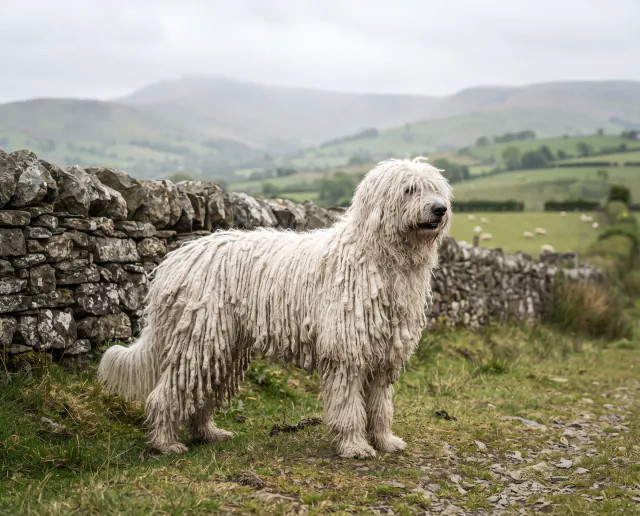
A flock of sheep moving across the Hungarian plain used to be almost indistinguishable from the dogs guarding it, because the Komondor was bred to look and move like one of its charges. That white, matted, unkempt appearance was never decorative. It let the dog sit among the sheep unnoticed by wolves at night and gave real protection against bites during the confrontations that followed. Everything about the breed, from colour to coat structure to the calm suspicion it shows strangers, traces back to a job with genuine physical stakes.
Modern Komondors rarely guard actual sheep, but the instincts have not been bred out. This is a dog that decides for itself whether a situation needs action, and it takes that responsibility seriously whether the flock is livestock or the family asleep upstairs. Owners considering one should be honest about whether they want a working guardian’s temperament inside a domestic setting.
Suitability
The Komondor answers to few people well and tends to attach itself to a small number of household members rather than the world in general. Strangers approaching the property, particularly at night, are treated with deep suspicion, and visitors need proper introduction before the dog accepts them. Children raised alongside the dog are usually well protected and gently treated, but a Komondor’s size and independent judgement make supervision essential with visiting children it does not know. The breed is not naturally playful in the way many family dogs are, and affection tends to be shown through steady presence rather than exuberant greeting. A rural property with defined boundaries suits the temperament far better than a busy street.
Exercise
Daily needs are moderate rather than demanding, and a Komondor kept as a working guardian may cover considerable ground simply patrolling its territory without a formal walk at all. In a domestic setting, forty five minutes to an hour of steady activity, ideally including some free roaming in a secure garden, keeps the dog settled. This is not a breed for running partners or repetitive fetch games, since it was never selected for that kind of drive. Puppies need particularly gentle handling of exercise, since the giant frame grows quickly and joints are vulnerable to strain from excessive jumping or forced road work before maturity.
Grooming
The corded coat is the single biggest commitment in owning this breed. Cords form naturally from puppyhood as the soft undercoat tangles with the coarser outer hair, and once established they need regular separating by hand to stop them fusing into a solid mat against the skin. Bathing a fully corded adult can take the better part of a day, since water has to be worked through and dried out of the coat thoroughly to avoid a musty smell or skin problems underneath. Many owners keep the coat clipped shorter for practicality, which reduces upkeep considerably but loses the traditional appearance. Whichever route is chosen, the coat needs planning for from the first weeks the dog is home, not once cords have already formed.
Health
Like most giant breeds the Komondor is prone to hip and elbow dysplasia, and breeders should be able to produce hip and elbow scores under the BVA and Kennel Club scheme for both parents. Bloat, or gastric dilatation and torsion, is a real risk in deep chested giant dogs and owners should know the warning signs and act on them without delay. The breed’s dense coat can mask weight gain and skin issues alike, so hands on checks matter more than a visual glance. A well bred Komondor commonly reaches ten to twelve years, respectable for its size, provided weight is managed carefully through a slower growing puppyhood and a steady adult diet.
Choosing and training
Training a Komondor asks for patience and consistency rather than repetition, since the breed was selected to think independently and can find rote obedience work uninteresting. Early, wide socialisation matters enormously, exposing the puppy to visitors, other animals, traffic and ordinary household comings and goings so that its guarding instinct develops proportionate judgement rather than blanket suspicion. Firm, calm boundaries set from puppyhood are far easier to establish than corrections applied later to an adult of this size and conviction. Litters are uncommon outside Hungary, and anyone serious about the breed should expect to contact the breed club, wait for a suitable litter, and meet working adults before committing.
Verdict
The Komondor suits an experienced owner with rural space, existing livestock or a large secure garden, and a genuine interest in a guardian rather than a conventional companion dog. It rewards people who respect its independence and do not expect constant biddability.
It is entirely wrong for a first dog, a suburban terrace, a household wanting an easygoing pet, or anyone unwilling to commit years of coat maintenance from puppyhood onward. Size, coat and temperament together demand a specific kind of home.