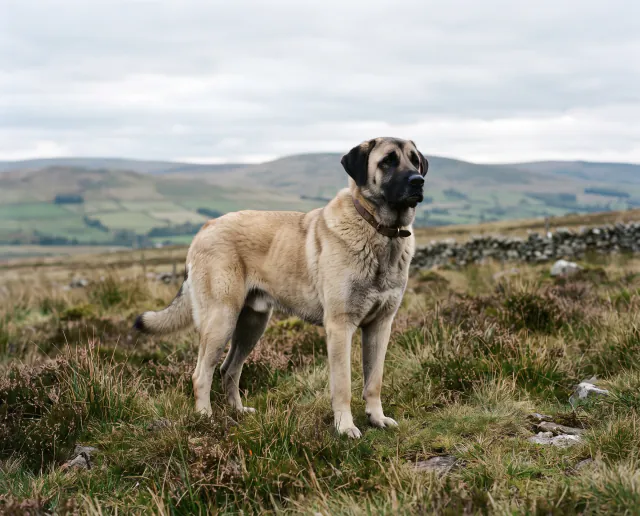
Also known as: Anatolian Karabash Dog.
At a glance
Key facts
The essentials to compare before deciding whether this breed fits your home and routine.
- Size
- Giant
- Lifespan
- 11 to 13 years
- Energy
- Medium
- Temperament
- Independent, watchful and calmly protective of territory
- Good with children
- Often good with supervision and firm boundaries
- Exercise
- About 45 minutes of steady walking a day, with room to patrol
- Trainability
- Experienced handler
- Grooming
- Weekly brushing, with a heavy seasonal blow twice a year
- Estimated monthly cost, GBP
- £150 to £260 per month
Long before border collies were driving sheep across British hillsides, dogs very like the Anatolian Shepherd were guarding flocks across the high plateau of central Turkey, sleeping among the animals rather than herding them. The breed was never bred to move stock. Its job was to stand between a flock and a wolf or a bear, and every physical trait, from the deep chest to the heavy bone to the sheer scale, still serves that original purpose.
A grown male can weigh well over 60 kilograms and stand above 70 centimetres at the shoulder, built more like a mastiff crossed with a sighthound than a typical pastoral dog. Owners who take one on without livestock still get a dog wired for the same work, watching a perimeter, deciding for itself what counts as a threat, and acting on that judgement without waiting to be told. That independence, more than the size, is the thing to understand before bringing one home.
Suitability
This is a dog for someone who has kept large, strong willed breeds before and who has secure land to put behind a proper fence. Anatolians are naturally suspicious of strangers and territorial about their own ground, traits that were selected for over centuries and cannot be trained away, only managed through early and continuing socialisation. Within the family most are calm, affectionate and remarkably gentle for their size, but visitors need to be introduced properly rather than simply let through the gate. A flat, a small garden or a household that wants a dog to greet callers warmly is the wrong setting. Public liability insurance and a boundary well above a metre are practical necessities rather than optional extras. Children raised alongside the dog usually do well, though the sheer bulk of an adult means supervision matters regardless of temperament.
Exercise
The breed’s energy is steadier than its size suggests. An Anatolian bred for guarding spends much of the day patrolling and resting rather than running, and a daily walk of forty five minutes to an hour, combined with the freedom to move around a secured garden, suits most adults well. Recall cannot be relied on around livestock, wildlife or an unfamiliar dog, so off lead exercise belongs inside fully enclosed land rather than open countryside. Puppies grow into a very heavy adult frame and should have exercise kept deliberately short and gentle, with stairs, jumping and long walks avoided until the growth plates have closed, usually around eighteen months. The coat and constitution cope well with cold and with heat, a legacy of the Anatolian plateau’s climate extremes.
Grooming
The dense double coat sheds steadily through the year and then heavily during two seasonal changes, when daily brushing for a couple of weeks keeps the volume of loose hair under control. Outside those periods a weekly session with a slicker brush and a comb through the neck ruff is enough. The coat is largely self cleaning and carries little odour, which is one of the more forgiving aspects of ownership. Nails need regular attention given the dog’s weight bears directly on them, and ears and teeth should be checked on the same routine as any large breed.
Health
Hip and elbow dysplasia occur in the breed as they do in most giants, and a buyer should ask to see BVA and Kennel Club hip and elbow scores for both parents rather than take reassurance on trust. The deep, narrow chest carries the same bloat risk seen in other large guarding breeds, and owners should learn the signs, a swollen abdomen, unproductive retching and sudden restlessness, and treat them as an emergency rather than something to watch overnight. Entropion, where the eyelid rolls inward, is recorded in the breed and is a straightforward surgical fix when caught early. Keeping a dog of this size lean matters enormously for joint health over a working lifetime, since every extra kilogram multiplies the load on hips already carrying a heavy frame.
Choosing and training
Anatolian Shepherd Dogs remain uncommon in most countries, and anyone wanting one should expect a wait and should go through the breed club rather than a general listing site. Meeting both parents, or at least the mother, gives a far better sense of adult temperament than any puppy behaviour will. Training should start on day one with calm, consistent handling and wide early exposure to people, situations and other animals, because a dog that reaches adulthood without that grounding will make its own decisions about what is safe. Harsh correction tends to produce a guarded, harder dog rather than a compliant one, and food based reward work goes further. Raising a puppy this size costs more in food, veterinary care and equipment than a typical breed, and that expense should be budgeted for well before the dog arrives rather than discovered afterwards.
Verdict
The Anatolian Shepherd Dog suits an experienced owner with secure land, realistic expectations about guarding instinct, and the patience to socialise a giant breed properly from puppyhood. It rewards that investment with a calm, watchful companion that asks for comparatively little in the way of constant activity.
It is the wrong choice for a first dog, for anyone without a securely fenced property, or for a household that wants a naturally friendly greeter for every visitor. Underestimating the guarding instinct, rather than the size, is what causes most problems with this breed.