Also known as: Great Pyrenees.
At a glance
Key facts
The essentials to compare before deciding whether this breed fits your home and routine.
- Size
- Giant
- Lifespan
- 10 to 12 years
- Energy
- Medium
- Temperament
- Calm, protective and quietly independent
- Good with children
- Usually very good with family children
- Exercise
- About an hour a day, with room to patrol
- Trainability
- Experienced handler
- Grooming
- Brushing several times a week, with a heavy seasonal blowout
- Estimated monthly cost, GBP
- £160 to £250 per month
For centuries a shepherd in the high Pyrenees needed a dog that would decide things for itself. Wolves and bears did not attack on a schedule, so the flock guardian had to patrol through the night, judge a threat without instruction and act on its own authority long before a human arrived. The Pyrenean Mountain Dog was shaped entirely by that job, and the dog sold today still carries the same instincts, minus the wolves.
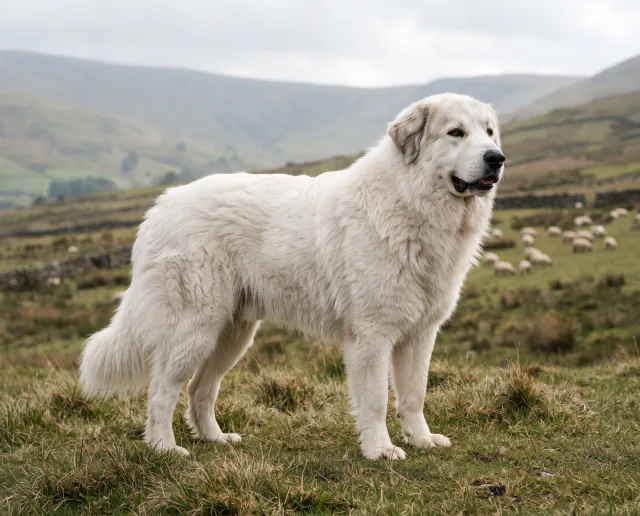
Seen across a farmyard the breed looks almost soft, a broad white coat and a gentle expression that gives little away. Handled at home, the independence becomes obvious within days. This is not a dog that waits to be told what matters. It has an opinion about the boundary of its territory, the arrival of strangers and the correct hour to start checking on things, and none of that switches off because the flock has been replaced by a garden fence.
Suitability
Families who already understand a working guardian breed tend to do well with a Pyrenean Mountain Dog, because the dog reads as protective rather than needy and is usually patient and gentle with children it has grown up alongside. Visitors are a different matter. A dog bred to challenge anything unfamiliar approaching its flock will treat an unannounced caller the same way, and early, consistent socialising with people, other dogs and everyday noise is not optional. First time owners can manage the breed, but only with real commitment to that groundwork and to a secure boundary from the outset, since a bored or under supervised dog of this size and independence causes proportionate damage. Cats and smaller pets usually settle in fine once the dog accepts them as part of the household it guards.
Exercise
Physically the breed is not demanding. An hour of walking a day covers most adults, and many are happiest pottering around a large garden, checking the perimeter and lying somewhere with a clear view rather than running hard. What matters more than distance is territory. A dog that patrols by instinct needs somewhere secure to do it, and a run around a small enclosed yard satisfies that need far better than a longer walk on a lead through town. Puppies should be kept to gentle, short outings while their frame develops, since rapid growth on a giant skeleton is easily overloaded by repeated jumping, stairs or long runs.
Grooming
The coat is thick, weather resistant and designed to shed rain and snow, with a soft undercoat that blows out heavily once or twice a year. During those weeks daily brushing is realistic, and the volume of loose hair surprises most new owners. Outside the moult, two or three sessions a week with a slicker and a rake through the undercoat keeps mats from forming behind the ears, under the legs and around the trousers at the back end. The white coat shows dirt readily but sheds mud once dry, so a stiff brush after a wet walk often does more good than a bath. Nails, ears and the double dewclaws found on the hind legs all need regular checking.
Health
Reputable breeders screen breeding stock for hip and elbow dysplasia under the BVA and Kennel Club scheme, and buyers should ask to see both parents’ scores rather than take reassurance on trust. Bloat, or gastric dilatation and volvulus, is a real risk in a deep chested giant breed, and owners benefit from knowing the warning signs, restlessness, unproductive retching and a swelling abdomen, and treating them as an emergency rather than something to watch overnight. Heart problems and a degree of entropion affecting the eyelids are also worth asking about. A giant frame carries extra strain through hips and joints if the dog runs heavy, so keeping the animal lean throughout its life protects mobility more reliably than any supplement.
Choosing and training
Training works best through patient, reward based methods that respect the breed’s independent streak rather than trying to override it. Harsh correction tends to produce a dog that disengages rather than one that complies, while calm, repeated boundary setting from puppyhood, particularly around guarding behaviour toward visitors, pays off for years afterward. Litters are not common, and buyers should expect a wait for a breeder who health tests properly and raises puppies with genuine early exposure to household life. Meeting the parents, ideally in a home rather than a kennel setting, tells a prospective owner far more than photographs. The breed club is worth contacting early, both for waiting lists and for honest advice about whether a household is really suited to a dog this size and this self directed.
Verdict
The Pyrenean Mountain Dog suits a rural or semi rural household with secure boundaries, room for the dog to patrol, and owners willing to manage a genuinely independent guardian rather than a biddable companion. Calm households that respect the breed’s instincts rather than fight them tend to get a devoted, gentle and remarkably tolerant family dog in return.
It is a poor match for a suburban terrace, an owner hoping for off lead reliability near livestock or wildlife, or anyone unwilling to deal with nuisance barking at night. Anyone drawn mainly by the striking white coat should spend time with an adult dog in a working or home setting before committing to the temperament underneath it.