Grooming an older dog is rarely about doing less. It is about doing the same essential tasks differently, in a way that accounts for thinner skin, sore joints, reduced stamina and, sometimes, a shorter temper for handling that was once tolerated without complaint. A routine that worked comfortably for years does not automatically stay comfortable as a dog ages, and continuing it unchanged can mean missing signs that the process itself has become harder for the dog than it used to be.
This guide covers the practical adjustments worth making to grooming as a dog gets older, and when it becomes sensible to talk to your vet about alternatives such as sedated grooming or a groomer who visits at home. The health-check side of ageing, including what changes in an older dog are worth raising with a vet, is covered separately in senior dog health checks and mobility changes in dogs.
Gentler handling for thinner, more fragile skin
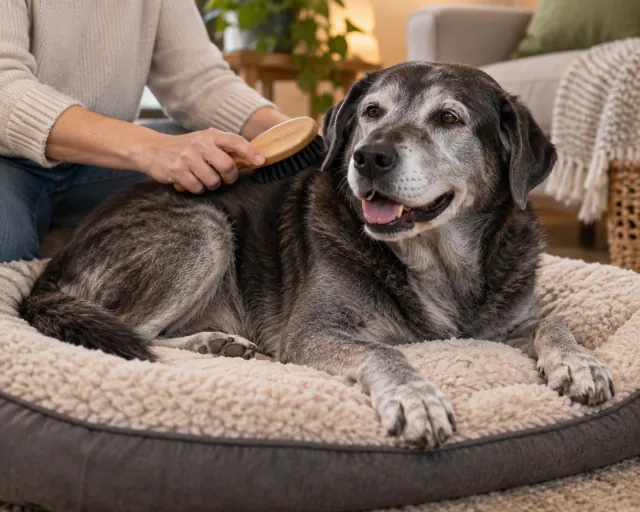
Skin often becomes thinner and less elastic with age, and can bruise or tear more easily than it did in a younger dog. A slicker brush or comb used with a firmness that was perfectly comfortable years ago can become genuinely uncomfortable on older skin, so it is worth deliberately softening your pressure and checking in more often for a flinch or a pulled-away paw than you might have needed to previously.
Older skin can also be drier, and some dogs develop more noticeable skin changes as they age, covered in skin and coat health checks. Where a coat and skin have become more sensitive generally, a softer-bristled brush used more frequently, in shorter sessions, often does the job with less discomfort than a firmer tool used less often.
Shorter, more frequent sessions instead of one long groom
Standing still for an extended grooming session, or being lifted onto a table and held there, asks more of an older dog’s joints and stamina than it does of a younger dog’s. Rather than one long session covering the whole coat, several shorter sessions spread across the week are often easier for an older dog to manage comfortably, even if the total time spent grooming stays similar.
Watch for signs that a session has gone on too long: shifting weight repeatedly, trying to lie down, panting that was not present at the start, or general restlessness. These are reasonable signals to stop and finish the rest another time rather than pushing through to complete the whole coat in one sitting because that used to be the routine.
Extra care around lumps and sensitive joints
Older dogs develop new skin lumps more often than younger dogs, and most are handled correctly by noting them and getting them checked rather than treating them as an automatic emergency, as covered in routine health checks at home. During grooming, work around any known lump carefully rather than brushing or clipping directly over it, and mention any new lump found while grooming to your vet rather than assuming it is the same as previous harmless ones.
Sore or arthritic joints change how an older dog can be positioned comfortably for grooming. A hip that used to allow a leg to be lifted and extended without complaint may no longer manage that range of movement comfortably, and forcing a limb into a position that has become painful will make the dog dread grooming rather than tolerate it. Let the dog find a comfortable stance where possible, support weight where needed rather than expecting the dog to hold an awkward position unaided, and avoid restraining a joint in a stretched position for longer than necessary.
Coat changes that come with age
It is common for an older dog’s coat to change texture, sometimes becoming coarser, sometimes thinner or more brittle, and greying is common around the muzzle and face in particular, though it can appear elsewhere too. These changes are generally a normal part of ageing rather than a sign of a problem on their own. A coat that changes texture may also need a different brush than the one that worked well for years, so it is worth reassessing tool choice against the guidance in grooming tool basics rather than assuming the old brush is still the right one.
Sudden or patchy hair loss, rather than a general gradual change in texture or colour, is a different matter and is covered in shedding and seasonal coat changes, which explains what falls within a normal pattern and what does not.
Keeping up dental, ear and nail care despite reduced cooperation
Nails, ears and teeth do not become less important to check as a dog ages, and in many cases matter more, since nail overgrowth affects an already less stable gait, ear problems can compound with other age-related discomfort, and dental disease tends to worsen if left unmanaged for years. The specific approaches to each are covered in nail care for dogs, ear care for dogs and dental care routines for dogs.
An older dog may become less cooperative about this handling than it once was, sometimes because of discomfort elsewhere in the body rather than the specific task itself. Where a previously tolerant dog starts resisting nail trims, ear checks or having its mouth examined, treat that change itself as worth mentioning to a vet, since a sudden drop in tolerance for routine handling can sometimes point to pain somewhere else that has nothing directly to do with the grooming task.
When a normal salon visit becomes too much
Some older dogs, particularly those with significant mobility loss, cognitive changes or anxiety that has worsened with age, reach a point where a standard groomer visit, with its table, restraint, noise and unfamiliar handling, becomes genuinely distressing rather than merely tolerated. This is worth discussing directly with your vet rather than persisting with a routine that has stopped working.
Two options worth raising are a groomer who will visit the dog at home, avoiding car travel and an unfamiliar environment altogether, and sedated or assisted grooming carried out under veterinary guidance for a dog who cannot otherwise be groomed safely or comfortably. Neither is a routine first step, and your vet is best placed to weigh whether a dog’s individual health and temperament make either appropriate. The aim throughout is keeping essential care going in whatever form the individual dog can genuinely tolerate, rather than either forcing an unchanged routine or letting grooming lapse altogether because the old approach has stopped working.